
The Inspiration Of Joey Martin
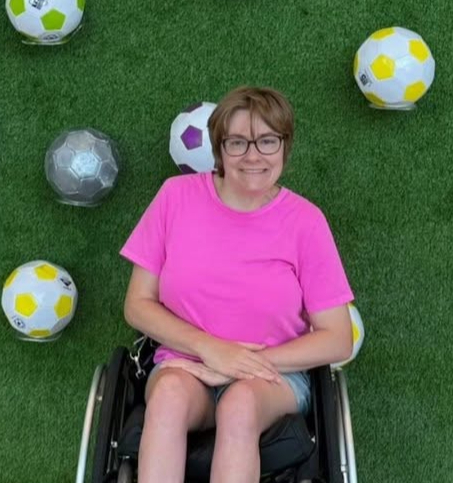

Not going to lie—this one is deeply personal.
A week after her team’s World Cup triumph, I had the pleasure of interviewing U.S. Women’s CP National Team defender Joey Martin about resilience, the growth of extended national teams, and what it truly means to build community.
My love affair with soccer began at five, when my best friend James invited me to his adaptive soccer practice. That same summer, after watching the Lady Nats dominate in the 2004 Olympics, I became completely hooked, convinced I was destined to become the next Abby Wambach. Born with spastic cerebral palsy, I didn't reach the Olympic stage, but I played soccer recreationally for the next ten years, maneuvering the pitch with my walker.
After stepping away from sports writing for nearly a decade, this was the pitch that got me excited to wade back in. I’m so thankful to Jason and everyone at SDH for their support of this story. While the members of the CP National Team are ambulatory and play without mobility aids on the pitch, hearing Joey speak about representing the disability community hit close to home. Her journey speaks directly to the shared experience of every kid who ever stepped onto a pitch—with or without an assistive device—wondering where they fit in.

A Different Path to the Pitch
Joey’s path into the disability community unfolded differently than mine. While I spent my entire life learning to maneuver with CP, Joey was able-bodied for the first 15 years of her life. She had played soccer since age four and was in peak shape preparing for high school varsity tryouts when her life shifted overnight: she was diagnosed with a brain tumor.
"My story is a little different because I left the school I was at after 8th grade and went to a completely different school with about 150 kids in my class... When I had my brain tumor, I had only been at this new school for about four months," Joey explained. "When you're 15, some people don't know how to deal with it."
While navigating cancer treatment and returning to high school after brain surgery, Joey found that her core support system anchored her. "My best friend before the diagnosis stayed my best friend—we didn't skip a beat, and we're still besties to this day," she shared. "For anyone who treated me a little differently initially, I don't hold a grudge; high schoolers are just learning how to handle something major like a brain tumor. By senior year, everyone treated me like a normal girl."
Surviving cancer and rebuilding her body after brain surgery made her aware of a whole new world. "My mind has been opened to the entire disability community," Joey said. "My goal now is to spread awareness about diseases, CP, or whatever it is, because it's not an indictment on the person. Rather, it should be celebrated for how tough they are and how amazing it is that they are overcoming whatever they're facing and then going to play."
Mental Toughness and Finding Belonging
That adjustment to a changing body post-surgery was a mental battle as much as a physical one. Before she began playing CP Soccer, Joey played able-bodied soccer as a disabled athlete. She recalled having to work heavily on self-talk and confidence—especially in moments when opponents would run right past her, making it look like she wasn't trying even though she was giving everything she had.
Her experience deeply resonated with me. Anyone navigating the game with physical impairments knows that exact feeling: the internal struggle of accepting that your body moves differently, recalibrating expectations, and learning to focus entirely on the next play.
For Joey, joining the U.S. Women’s CP National Team provided something she had struggled to find as a cancer survivor: peers who truly understood.
"Before finding this team, I really struggled to find people my age who had experienced a brain tumor," she recalled. "In finding this team, I found girls who may not have the exact same disability, but share similar manifestations—like balance issues or eye issues. Having that shared experience and support system has been nothing short of remarkable."
World Cup Triumph and the Evolution of the Game
Coming off their World Cup victory, Joey reflected on how rapidly the stage for women’s CP soccer has elevated under IFCPF, the governing body of CP football. Comparing the 2022 World Cup (her first) to the recent 2026 tournament, Martin agrees that the progression in scope, international investment, and recognition has been palpable.
"US Soccer, including extended national teams—from CP soccer to deaf and power soccer—under one umbrella and giving us world-class facilities designed for our needs shows how far the sport has come. We're not just playing a game; we're establishing a standard for what adaptive athletics should look like."
True progress means giving the extended national teams the same platform and backing as youth and senior squads. Today, all nine programs under the Extended umbrella—comprising men’s and women’s CP, Beach, Deaf, Futsal, and the co-ed Power Soccer team coming off a Bronze medal finish at the World Cup in Argentina—broadcast their matches live on YouTube, ensuring supporters worldwide can tune in free of charge.
Tactically, the international game is pushing boundaries as well. Currently played in a 5v5 format on a basketball-court-sized pitch, the game demands high positional fluidity and player versatility—such as field players stepping into goal when injuries arise.
"The 5v5 game is so fast, but as the international player pools expand, scaling to 6v6 and 7v7 will completely change the tactical landscape. The growth of extended national teams isn't just happening in numbers—it’s happening in the level of play on the pitch.”
Community Impact and Visibility
The ongoing World Cup triumphs of the CP National Team ripple directly down to the grassroots level. Through initiatives such as Atlanta's annual Adapt & Thrive Invitational, national squad members engage face-to-face with local adaptive programs, including TopSoccer, Down Syndrome Soccer, and CP Soccer Atlanta. Joey shared a heartwarming memory of forming a close connection with a young player from CP Soccer Atlanta who views her as an inspiring World Cup champion.
"It was so special to form a connection with her and know what our team means to people," Joey said. "I'm really just trying to go out on the field and have fun playing with my friends, but being on this team has made me realize we have such a great impact. The kids who see us playing and see themselves in us—that is mind-blowing."
When asked how she handles being labeled "inspirational," Joey deflects the praise, pointing to her faith, her parents, physical therapists, and medical team who helped rebuild her after brain surgery. Her advice to young disabled athletes is to embrace cross-training—like swimming or running to strengthen impaired muscle groups—and to prioritize self-talk and mental health.
This, too, speaks to my experience as a disabled athlete. I am among the 32.9% of disabled Americans who struggle with their mental health. Exercising three times a week helps me manage my anxiety and depression. Engaging with my community doesn't feel "inspirational" to me—it is simply a natural dimension of leading a well-rounded life.
As our conversation wound down, I found myself thinking about the shared threads between us—Joey and me: both university students, both Spanish minors, both dedicated to spreading knowledge and advocating for the community that disabled sports has given us both.
Looking back on my childhood on the field, long before the CP National Team existed, I think about how transformative it would have been to see an athlete like Joey winning a World Cup on home soil and representing our country on the world stage.
This story is for everyone watching from the sidelines. But before all that, it's for the little girl who first kicked a soccer ball 22 years ago.

Comments