
Training Ground Notebook: Stian Gregersen talks progress, Jay Fortune talks comeback

Gregersen offered a clear look at Atlanta’s growth after Philadelphia, while Fortune gave an honest account of the pain, patience, and hope inside his comeback.
Tuesday’s media availability gave two very different windows into where Atlanta United is right now.

Stian Gregersen spoke from inside the momentum of Saturday’s first win, breaking down what changed against Philadelphia, what Tata Martino still wants sharpened, and how he has worked to put himself in a better physical position this season. Jay Fortune came from the other side of the process, reflecting on the long road back from a season-ending foot injury in 2025 and what it meant to finally play 45 minutes again with Atlanta United 2 on Sunday in Athens.
Put together, the two conversations told a bigger story about Atlanta’s current moment. One player was describing how the team is trying to build on its first breakthrough result of the season. The other was describing how he is trying to rebuild his way back into that picture.
Gregersen sees a team starting to find its footing
Gregersen had to wait for his chance. After not playing in Atlanta’s first three matches, he stepped into the lineup against Philadelphia with Juan Berrocal out injured and helped the team earn its first win of the season. He said, “I have been patient and worked hard,” and when the opportunity finally came, “it was great that we won the game.”
That patience matters in the context of this group. Gregersen said he has had direct conversations with Martino about what he needs to improve, and he did not dodge the question when asked what area had been emphasized. “It’s the building up,” he said, a revealing answer for a team whose demands on center backs go well beyond pure defending.
His comments on the Philadelphia match also offered a useful look at how Atlanta viewed the defensive side of that performance. “I think we handled it very well,” Gregersen said. “During the week before the game we had in the training ground, we practiced on the crosses.” He noted that Philadelphia sent “almost 30 crosses against us in the game,” and that Atlanta “defend[ed] our boxes very well.”
That matters because Philadelphia asked Atlanta a lot of uncomfortable questions. The Union played quickly, played directly, and forced Atlanta’s defenders into repeated moments of recovery and box defending. Gregersen’s view was that Atlanta was ready for it and, more importantly, stood up to it. That is a valuable step for a team trying to play more aggressively and spend more of the game on the front foot.

What “protagonist” means in practical terms
One of the most revealing moments in Gregersen’s availability came when I asked him how he interprets Martino’s idea of being a protagonist.
His explanation was simple and useful. “He really want to control the game,” Gregersen said. “So we have to be on the front foot to not get this transition against us. So that’s why he want to win it back straight away, and then we can control the game more.”
He also offered an important bit of honesty about the Philadelphia win. “When we got 3-0, then we played a lot (for) the result instead of playing our style,” he said. “That’s fine, because we really did need that three points, but hopefully we can do controlling more game during the season.”
That is an important distinction. Atlanta got the result it badly needed, and nobody inside the team is going to apologize for that. But Gregersen’s answer suggests the group still sees another level to reach. Winning was necessary. Controlling matches more completely is still the target.
He also tied that idea back into the attack. From his perspective, when Atlanta does its defensive work, it still has to be cleaner and quicker in how it connects to the front players. “We have to feed them more,” Gregersen said. “We have to look up, find them into the correct spaces, especially now... with two number tens and high fullbacks.”
That is a useful tactical clue. Good defending is only part of the sequence. The next step is turning those ball-winning moments into cleaner service for players like Miguel Almirón and Emmanuel Latte Lath.
A healthier Gregersen could matter as much as a sharper one
Gregersen also gave a candid update on the work he did after last season’s physical struggles.

He acknowledged that he worked hard in the offseason to improve his chances of staying available this year, describing a different preparation process around training and recovery. He also mentioned blood testing as one of the tools helping him better understand what his body needs. “It will help me a lot because you can see the inflammation and stuff like that in your body,” Gregersen said. “So we can manage that in terms of how hard you can train.”
That is a significant detail for Atlanta. In a system that can leave center backs isolated, covering space, and defending in transition, the team needs players in those positions who are not only capable of handling the demands but available often enough to build continuity. Gregersen made it clear that he believes he can handle those moments. “I think I can handle it very well because of my speed and the physical,” he said.
He also spoke positively about the team’s mood after the win, saying the three points were “very, very important for us to get this confidence.” He added, “We all believe in the project,” and stressed that the group had stayed together and positive through the difficult start.
That does not erase the problems of the first three matches, but it does suggest the locker room sees the Philadelphia result as something to build from rather than just something to survive.
Fortune’s return was about more than just 45 minutes
If Gregersen’s side of the day was about the present, Jay Fortune’s was about the possibility of what Atlanta could soon add back into the squad.
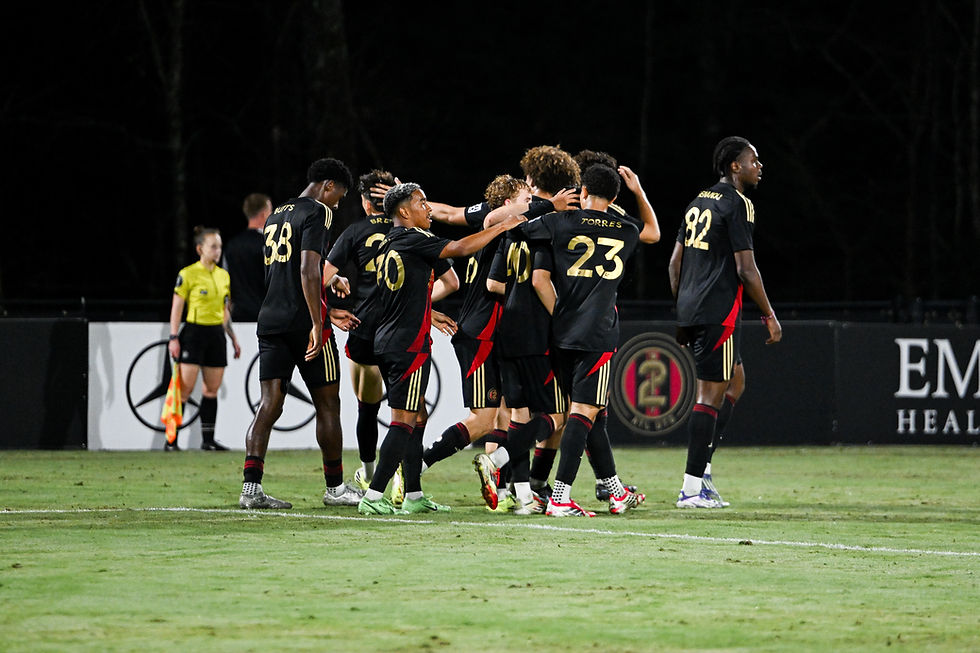
Fortune returned to action Sunday with Atlanta United 2, playing 45 minutes in Athens. He admitted the emotions before kickoff were real. When the match finally arrived, it brought both “fear and excitement,” and he said it was one of the most nerve-racking moments of his career. Still, once it started, he settled in and came away pleased to be back on the field.
The strongest parts of Fortune’s availability, though, came when he described everything that had to happen before that first whistle.

He walked through the injury itself, explaining that it happened during the Concacaf Gold Cup against Saudi Arabia in Las Vegas when his foot got stuck in the ground as he was pulled from behind. “I just had a pretty bad Lisfranc injury,” he said. “I tried to stand up and put pressure on my left foot, just realized I couldn’t do it.”
What followed was the much harder part. “It was a little tough hearing that the season was done because I was really enjoying football at the time,” Fortune said. “To hear that that was kind of being put to an end wasn’t fun.”
That is the human part of a return that can get lost when it is reduced to a simple availability update. Fortune was not just coming back from missed minutes. He was coming back from an injury that abruptly shut down a season in a moment when he felt his game was in a good place.
The mental side of the comeback
Fortune was especially powerful in describing the emotional reality of rehab.
“It was ups and downs for sure,” he said. “The first week or two after the injury, with all the medication and all the pain and stuff that you go through, you don’t really know what to think.” He called it “quite a sad time,” then quickly turned to the support structure that helped him get through it, saying family, teammates, coaches, and staff made the process easier.
He also described the grind of showing up every day when progress felt slow and the work itself could be painful. “Some days, didn’t want to do the work, didn’t want to do certain treatments because there’s pain with it,” he said. But he also described how small progress can change everything mentally: “When you do see the little bit of progress that you make, it goes a long way in these type of injuries. It brings a smile on your face for the next two to three days.”
That part of his availability felt especially revealing because it was real and human. It sounded like what rehab actually is: repetitive, frustrating, painful, and mentally draining, with progress often coming in increments small enough that you have to train yourself to notice them.
He said one of the best parts of the process was simply moving through the stages. “Getting off the scooter,” he said, was a milestone. So was “being able to walk,” but “probably jogging or throwing the boots back on was my favorite moment.”
Fortune also made it clear that he trusts his body again. “Quite a bit at the moment,” he said when asked directly. He credited the staff, the surgeon, and the gradual increase in workload, adding that each new phase left him feeling “in a good spot.”
That is probably the most encouraging competitive takeaway from his availability. He is not speaking like someone merely hoping to get through sessions. He sounds like someone who believes he is moving toward being himself again.
Family, teammates, and what comes next
There was also a lot in Fortune’s availability that spoke to the environment around him.
He talked at length about the support of his family, especially his brother and father, and how much it meant that they were there both in the immediate aftermath of the injury and at his return match on Sunday. The strongest line there may have been the simplest one: “The stadium could have been empty, to see those three would have been enough for me.”
He also described the support from Tristan Muyumba after the match and used that moment to speak more broadly about the group. “It’s like a family that we have here,” Fortune said, a line that matched the way he talked throughout the session about teammates helping pull him through the hardest stretches.
That matters because Fortune has always felt like one of the players whose value extends beyond a single tactical label. His availability reinforced that again when he was asked about competition in midfield and about where he sees himself positionally. He embraced the competition and made it clear he still backs himself to earn minutes, while also reinforcing the versatility that has long made him useful to Atlanta.
Atlanta is not simply waiting on a midfielder to regain fitness. It is waiting on one of its more adaptable pieces to re-enter the mix. Whether that becomes depth, rotation, cover, or eventually a stronger claim on regular minutes, Fortune’s return creates more possibilities.
Two different conversations, one useful picture
That was the value of Tuesday’s media availability.
Gregersen gave the view from inside the team’s current push forward. He spoke about confidence, control, box defending, build-up demands, and the need to keep sharpening the football even after finally getting a result. Fortune gave the view from a much longer timeline, one that ran through pain, isolation, rehab, and the emotional release of getting back on the field.
Together, they offered a pretty clear snapshot of where Atlanta United stands right now. The team is trying to turn one win into something more stable. And one of its most useful returning players is trying to make sure he is part of what comes next.


Comments