
Welcome Home: The Arthur M. Blank U.S. Soccer National Training Center Opens Its Doors


Sometime Friday morning, a 13-year-old boy will pull on a U.S. Soccer training kit, lace up his cleats, and walk out onto a natural grass field in Fayetteville, Georgia. He will not fully understand what he is standing in the middle of. He probably will not know that U.S. Soccer has existed for 113 years without a permanent place to call home. He will not think about the decades of coaches planning camps around borrowed facilities, the national teams that flew into cities and quietly trained on other people's grass, or the staff hours consumed by logistics that should have gone to development. He will just see the field, feel the turf beneath his feet, and get to work.
That is exactly the point.

The Arthur M. Blank U.S. Soccer National Training Center officially opened Thursday in Fayetteville with a ribbon-cutting ceremony that drew U.S. Soccer leadership, political figures, business leaders, and the man whose name adorns the building. The real opening act comes Friday morning, when the U-14 Boys' National Talent Identification Camp becomes the first national team training camp in the facility's history. Sixty of the country's best 13-year-olds, chosen from regional mini camps held across the country this spring, will represent the North, South, and West over five days of training that runs through May 13.
Later this month, the facility hosts its first national team competitions: the AdaptandThrive Invitational, which brings together all five of U.S. Soccer's disability national teams alongside youth organizations whose players share similar experiences, so that those kids can look up and see the path forward in the game.
It is a fitting, almost poetic, way to begin.
What Took So Long
For an organization that has governed American soccer since 1913, the absence of a permanent training home has been a defining and costly gap. The USSF has operated as a nomad for over a century, booking time at facilities controlled by MLS clubs, universities, and local soccer organizations. Always a guest. Never a host.

JT Batson, the USSF's chief executive and secretary general, has described the practical cost of that reality in blunt terms. His teams, he has said, could be "the fourth, fifth or sixth team in priority of using a facility in a day." The logistics of planning around that uncertainty amounted to a tax on every coaching staff, time that should have gone toward player development and tactical planning consumed instead by scheduling gymnastics.
That ends today.
Batson framed Thursday's opening in terms that go well beyond bricks and fields. "It's a physical manifestation of our ambition for U.S. Soccer and soccer in America," he said earlier this spring, calling the opening "just the start" of bigger plans. In his official remarks Thursday he was more precise: "The National Training Center is the product of a shared vision and deep partnership. Because of the commitment and hard work of so many, we've delivered a world-class facility on time and on budget, ensuring U.S. Soccer is in our new home ahead of the 2026 FIFA World Cup."

Parlow Cone, who played for the national team for years before becoming its president, has lived both sides of that story. As a player she was always in a bubble, she said Thursday, never interacting with other national teams or with the broader USSF ecosystem. As an executive she watched staff in Chicago work day and night for teams they would never see train. And she has been honest about what the absence of a home actually felt like from the inside.
"Sometimes it can feel a bit transient," she said. "Sometimes we talk about it like, oh, we're a bit of a traveling circus. We're going from different homes all the time. When you think about it, you think: how has that not happened for so long?"
When she walked into the completed building for the first time on Wednesday, the answer to that question became irrelevant. "I was thinking this is exactly what I had always dreamt it would be," she said. "No matter who you are, what level you're at in our game, you are welcome here. You should feel like we're wrapping our arms around you."
Her official statement at the ceremony put it with the precision of someone who has spent years waiting to say it: "The National Training Center represents so much of what we want U.S. Soccer to be. It honors the people who have built this game over more than a century, and it gives us a home where we can serve the next generation of players, coaches, referees, members and fans." The job now, she said, is to make sure everyone who walks through these doors feels like it belongs to them.
What They Built
The scale of what now sits on a 200-acre site just south of Atlanta in Fayetteville, near the town of Trilith, is staggering for anyone who has followed American soccer long enough to remember the days of makeshift national team camps at rented hotels. The campus currently occupies 123 developed acres, with room designed in for future expansion as the game grows. It features 17 outdoor playing surfaces: 13 regulation natural grass fields, two artificial turf fields, and two sand pitches for beach soccer. Total facilities exceed 400,000 square feet, including two indoor playing surfaces: one an artificial turf training hall, the other a full-size court for futsal and power soccer, the sport played by athletes in motorized wheelchairs.

The power soccer locker room is equipped with recharging portals for the wheelchairs. This is a building designed for every version of U.S. Soccer, not just the ones that make the highlight reels. The AdaptandThrive Invitational, the facility's first national team competition, underscores that from the start: the extended national teams have a home here too, not as an afterthought but as a pillar.
Beyond the fields: a high-performance center for weight training, conditioning, and nutrition; twenty locker rooms; nineteen meeting rooms; a ballroom; medical facilities; 400 workstations; cafeterias; a sleep room. Second-floor terraces overlook the primary senior field. Architecture and design firm Gensler, which has shaped some of the world's most prominent sports venues, drew the plans with what they called the goal of uniting "elite training and hospitality within a timeless campus designed to elevate the game for generations."
It is, in short, the kind of facility that signals to the world that American soccer is serious.
The People Who Made It Happen
The story of how a corner of Fayette County became the home of U.S. Soccer runs through a small group of names that carry enormous weight in Georgia business, philanthropy, and sports.

Arthur M. Blank, the Atlanta Falcons and Atlanta United owner who co-founded The Home Depot and has granted more than $1 billion to charitable causes through his family foundation, contributed $50 million to make the project possible. Through his family of businesses and his foundation, Blank has spent years arguing that purpose and profit belong together, that investment in community is not charity but strategy. It is a philosophy he traces back to Home Depot's founding in 1978, the idea that touching people's lives and helping them fulfill their dreams is not separate from business but the very center of it.
His path to soccer, he explained Thursday, began the way so many parents' paths do: through a child. His son Josh started playing at age five, Blank spent years following him through the youth soccer world, watching the energy on the pitch, the coaches, the community built around the game. That experience planted something. Then Don Garber, the MLS commissioner, called with an idea about bringing a team to Atlanta. By 2014 that was announced. By 2017 Atlanta United was playing, setting attendance records and winning an MLS Cup in just its second season.
A few years later, Garber called again with another proposition. U.S. Soccer, he explained, was 113 years old and had never had a true home. They had an office, but not a home. Blank said Thursday the distinction hit him immediately: "It's like having a house with no kitchen."
He met with USSF president Cindy Parlow Cone and CEO JT Batson. He knew within five minutes that he was going to get involved. What he recognized, he said, was not a business case or a real estate opportunity but something harder to quantify: "heart and passion and the vision for what a U.S. national center could be."
On stage Thursday, Blank spoke about why soccer specifically compels him, and the answer went well beyond sport. He talked about a country with 350 million people, a third of them young, and about a world that he believes is experiencing more separation than at perhaps any point in modern history. Soccer, in his view, works against that.
"Soccer helps build that sense of family and that connection," Blank said Thursday. "And part of everybody, we need a heart. We need a heartbeat. We need a home, if you will. And this home, this heartbeat, is something I couldn't be more proud of."
He was equally clear about what he hopes this facility becomes over the next decade, and the answer was not about trophies or rankings. "The benefit of the sport, and equally important for me personally, is the impact it's having on young people," he said, "getting them outdoors, getting them connected to each other, that human connection, which we're suffering with today in this country and suffering with worldwide. Soccer brings so many great human attributes together in the most beautiful way, as a byproduct of the brilliance of the sport being played."
As for having his name on the building, Blank deflected in the way people who mean it tend to deflect. "It's such a thrilling thing for me personally," he said, "but it's really about our shared values of everybody in this room and the opportunities that we share."
The land itself was donated by Dan Cathy and the Cathy family, whose Chick-fil-A empire and Trilith development have transformed this part of Fayette County into something far more than a Georgia suburb. On stage Thursday, Cathy spoke about what drew him to the project in terms that had less to do with soccer than with something deeper.
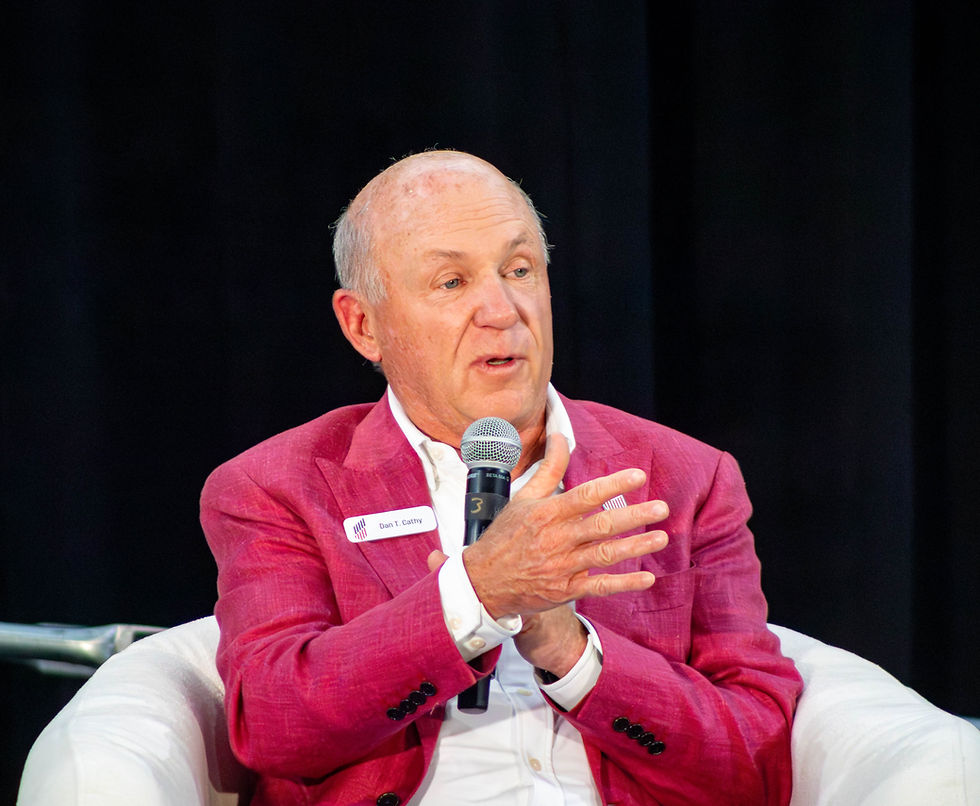
"That word home," Cathy said Thursday, reflecting on what the facility represents. "It has so many wonderful overtones to what it means to have a home, a place of love and acceptance. You feel cared for when you're home."
Cathy also pressed the point that the facility is about more than athletes. The families who travel with young players, the parents making enormous sacrifices to support their children's dreams, will be as much a part of this place as the players themselves. "A lot of parents are gonna come here," he said. "A lot of families are gonna come here."
His larger vision for the building is unmistakably human. For Cathy, the goal is to develop athletes "mentally, emotionally, physically, spiritually, and relationally," to see the person before the player, and to build character alongside skill.

Coca-Cola, whose Atlanta roots run as deep as any institution in the state, came in as a founding partner, contributing a $5 million grant through the Coca-Cola Foundation. Bea Perez, Coca-Cola's chief communications and sustainability officer, connected the investment directly to access, specifically to making sure young players from all backgrounds can experience the kind of mentorship and world-class environment the facility provides. "People from other countries will come just to see what's been created and what's been built," she said. "And I think we're gonna have an incredible story to tell in the next several months."
Michele Kang, who owns the Washington Spirit in the NWSL and pledged $30 million toward U.S. women's soccer initiatives in 2024, committed an additional undisclosed amount to the training center. Fayette County and the city of Fayetteville provided local support.
Fans can leave a literal mark on the building through U.S. Soccer's brick program, which allows supporters to purchase a commemorative brick to be displayed at the facility.
A United Culture Under One Roof

The training center will serve all 27 of U.S. Soccer's national teams: senior men's and women's programs, youth teams at every age level, and extended national teams including the beach soccer, futsal, deaf, cerebral palsy, and power soccer squads. For the first time, they will all share the same facilities, the same hallways, the same cafeteria.
Parlow Cone described a conversation she had Thursday with a coach from one of the extended national teams. "They were just like, this is awesome. You're my colleague. I can't believe we get the chance to shoot across the hallway and chat coaching." That, she said, is what the building is about: putting people together who are like-minded but different, to talk about how to move the game forward.

Emma Hayes, the USWNT head coach and one of the most celebrated coaches in the world, toured the facility and described something that surprised her about a building of this scale. "Regardless of the size and magnitude of this place, it's vast, especially outside," she said, "and it's really quiet and calming." She found the layout equally thoughtful: roll out of a classroom straight to the field, share a kitchen with colleagues between sessions, bring alumni in for dinner upstairs, watch the youth teams from an observation deck above. "It's a village," she said. "It's a community. There's a sense of belonging for everyone."
Hayes is also thinking about how the facility develops over time through what she calls a female-first lens. She spoke Thursday about nursing rooms for mothers, sleep pods for recovery, and a longer-term aspiration: a female leadership academy within the coach education program. "My dream would be to have a female leadership academy here," she said. The building opened yesterday. She is already thinking about what it can become.
Why Fayetteville
The choice of location raised eyebrows when it was first announced, given that the sport's American power centers have historically been on the coasts. But the logic of Fayette County holds up on examination.
Trilith Studios next door has turned this corner of Georgia into a genuine international production hub. Hartsfield-Jackson Atlanta International Airport, the busiest in the world, sits roughly 20 miles north. The city of Atlanta has become one of the most important soccer markets in the country, anchored by Atlanta United and one of the sport's most devoted fanbases. And the Southeast, long underrepresented in the national team pipeline, is a region where soccer has been quietly exploding for two decades.

For U.S. Soccer to plant its flag here is both a logistical decision and a statement. The game does not belong only to New York, Los Angeles, and Chicago. It belongs to Georgia, too. And Perez on stage Thursday captured what that means locally: "I think this is a moment where you're gonna see Atlanta be on the world stage because of the Arthur M. Blank U.S. Soccer National Training Center."
Hayes, who is English and came to Atlanta for the first time this week, offered a perspective unclouded by any local boosterism. She said she drove past the 1996 Olympic venue on the way in and had a personal jolt of recognition: that was the moment her father first told her about the U.S. Women's National Team. The connection between that history and what she is now building here landed on her in real time. "It's widely understood in the soccer community in this country that Atlanta and Georgia is a soccer place," she said. "To build on that is exciting."
She also raised the possibility of Atlanta hosting the 2031 Women's World Cup, an idea that is already circulating in soccer circles. "If there is a possibility of this being a major venue for '31, yeah, bring that on," she said. "That would be amazing." A permanent national home in Fayette County, an NWSL team arriving in 2028, eight World Cup matches this summer: the case for Atlanta as the capital of American soccer is no longer an argument. It is a résumé.
The World Cup Is Weeks Away
The timing of Thursday's opening cannot be separated from what is coming. On May 27, just three weeks from now, Mauricio Pochettino will announce the 26-man United States squad for the 2026 FIFA World Cup. The USMNT will then train at the new complex before traveling to Charlotte for their match against Senegal, returning to Fayetteville to train again, and then heading to Chicago for the game against Germany before departing for Los Angeles. The facility is not just the national home; it is the launchpad.
American soccer has spent years building toward a World Cup on home soil. The new training center is the final piece of permanent infrastructure that makes those ambitions feel real and grounded rather than aspirational. It is one thing to talk about building a dynasty. It is another to open the building where that dynasty will be forged.
Atlanta will host eight World Cup matches when the tournament opens in June. Blank, who has also been central to Atlanta's role as a host city through Mercedes-Benz Stadium, has been direct about the demand. "There's 104 matches with 48 teams. They're all going to be sold out," he said Thursday. "In Atlanta, for sure, the eight games here will be sold out completely."
The training center and the World Cup are two pillars of the same moment. Together, they represent something American soccer has never quite had before: a permanent home and a global stage, arriving at the same time.
But Batson was careful Thursday to frame the building's purpose as something that runs deeper than tournament cycles. U.S. Soccer has three generational ambitions, he said: win on the world stage, make soccer the most-played sport in every community in America, and make everyone who cares about the game feel connected to it. "Whether you're three or 13 or 33 when you're starting with soccer," he said, "our goal is to support you in your soccer journey throughout your life."
Back to the Kids
Which brings us back to the 13-year-old on the grass Friday morning.

He was not born yet when U.S. Soccer began dreaming about a national home. He will take the building for granted, the way every generation takes for granted what the one before it built. He will not feel the weight of 113 years of borrowed facilities and nomadic planning. He will not know that the land was donated, that the vision required years of relationship-building and philanthropic conviction, that an Atlanta businessman had to believe in something long before anyone could prove it would work.
He will just play.
But Arthur Blank, who has thought harder about why this building matters than perhaps anyone, offered a vision on Thursday that goes beyond the sport itself. We live, he said, in a moment of separation. People pulling apart from one another, communities fraying, the human connections that used to be assumed now requiring deliberate effort to build and maintain. Soccer, in his experience, is one of the few things that reliably works against that. It gets kids outside. It puts them on a team. It teaches them that most limitations are self-imposed, that they can always do more than they thought possible.
"It's the vision and the passion and the energy for the soul of soccer," Blank said, "and the soul of what soccer brings together."
Emma Hayes put it differently, and perhaps more simply, when she described what she hopes every player feels when they land at Hartsfield-Jackson and make the drive south to Fayetteville. "You say: I'm going home."
Parlow Cone, who has given more of herself to this place than almost anyone, called Thursday "a seismic moment in U.S. Soccer history." The word is not an overstatement.
The U-14 camp begins Friday. Sixty boys. Three regions. Soon there will be girls youth national teams, the AdaptandThrive Invitational later this month, and then the U.S. men's national team preparing for a World Cup in their own country.
One place. One home, finally.
And perhaps in 10 or 15 years, when one of those kids walks back through these doors as a senior international, he will understand what the building was really for. Not for the ribbon cutting. Not for the donors or the dignitaries.
For the next generation.


Comments