
The Atlanta Chiefs: How Atlanta's First Pro Soccer Team Built the Foundation

This page is part of the Soccer Down Here Soccer Reference Desk history of soccer in Atlanta. It covers the original Atlanta Chiefs, 1966 to 1972. A separate page will cover the second Chiefs era, 1978 to 1981.
"When you say you're with Atlanta, then people know and understand. Atlanta is U.S. soccer to people around the world." — Vic Rouse, Atlanta Chiefs head coach, February 1969
1. The Decision: Why Atlanta and Why Soccer in 1966
When the National League's Milwaukee Braves announced they were moving to Atlanta for the 1966 season, the centerpiece of the deal was a brand new facility on the west side of downtown: Atlanta Stadium, a multipurpose bowl designed to host both baseball and football. The NFL's expansion Atlanta Falcons were announced the same year. Two major league franchises in a single calendar year gave Atlanta the metropolitan legitimacy it had been chasing for a decade, and the stadium that made it possible needed to earn its keep on as many nights as possible.
The summer of 1966 accelerated things considerably. England hosted the World Cup, and for the first time the final was televised in the United States. The reaction to that broadcast created a genuine groundswell of interest from sports investors who had been watching soccer's global scale from a distance. The United States Soccer Football Association had already been convening meetings and forming committees about the possibilities of a nationwide professional league. Once the World Cup footage hit American television sets, the pace of those conversations went from deliberate to urgent almost overnight.
Two rival leagues emerged from that urgency, racing each other to the starting line rather than pooling resources. The United Soccer Association was sanctioned by the national federation. The National Professional Soccer League was not. The infighting between the two leagues would haunt professional soccer in the United States for years and contributed directly to both leagues' eventual merger into the North American Soccer League in 1968. But in 1966, with Atlanta Stadium sitting open and the Braves organization looking for content to put in it, the question of which league was sanctioned mattered less than the question of whether soccer could work in Atlanta at all.
Owner Bill Bartholomay tasked a young executive named Dick Cecil with figuring that out. Cecil, a Nebraska native who had come to Atlanta with the Braves, had no deep background in soccer. What he had was the organizational instincts of a good sports administrator and enough self-awareness to know the first thing he needed to do was find the right soccer person to run the team. He found him in Phil Woosnam.
2. Building the Club: Cecil, Woosnam, and the Blueprint
Phil Woosnam was not a typical hire. He was a university-educated Welshman who had played professional football in England for West Ham United and Aston Villa, earned 17 caps for the Welsh national team, and spent the later portion of his playing career thinking seriously about how the game could grow in North America. He came to Atlanta not just to coach a soccer team but to plant a sport in soil that had never seen it before.
The plan that Cecil and Woosnam built together reflected that ambition. It was not primarily about league standings or gate receipts, though both mattered. It was about using a professional team as an engine to generate soccer participation throughout the region. The Chiefs would play games, yes. But they would also run camps and clinics, visit schools, drive into the surrounding counties, and put players in front of children who had never seen the game played at any level. They would create the audience before they asked it to show up.
One of the more revealing details of how Woosnam understood his mission came in an early interview, where he reflected on the gap between what soccer had in England and what it had in Atlanta.
"I've been trying to do here in 100 days," he said, "what it took England 100 years to do."
The blueprint had a specific rule embedded in it that shaped everything that followed: players signed by the Chiefs had to speak English. The community clinics only worked if the players delivering them could communicate with the children and parents attending. That rule produced something historically significant about the Chiefs' rosters that has been largely overlooked. Yes, the team signed a number of British players, as one would expect from Woosnam's network. But it also signed a remarkable number of players from Africa and the Caribbean at a time when almost no other American professional sports franchise was doing anything similar. More on those players below.
Before the first ball was kicked, Cecil and Woosnam also invested in the people who would tell Atlanta's story back to itself: the sportswriters. Ahead of the 1967 season, the Chiefs organized a press trip to London for Atlanta sports media. Among those who made the journey was the legendary Larry Munson, the broadcaster who then worked for the Atlanta Braves but would later define Georgia Bulldogs fandom for generations. Jesse Outlar of the Atlanta Constitution watched West Ham play at the Boleyn Ground and compared the atmosphere favorably to a college football Saturday at Sanford Stadium in Athens, which for an Atlanta sportswriter in 1966 was as high a compliment as existed. The men who would write about the Chiefs for the next six years now had a context for what they were watching. Cecil understood that was worth the cost of the trip.
3. Year One: 1967, Getting Atlanta's Attention

Atlanta professional soccer began on the evening of April 22, 1967, at Atlanta Stadium, in a home opener against the San Diego Toros that drew 11,293 fans. The first goal in the history of professional soccer in Atlanta was scored by Phil Woosnam himself, a fitting marker for a man who embodied everything the organization was trying to do. The match ended 1-1.
Atlanta Journal sports editor Furman Bisher was in the press box that night, and his description of the crowd captured something real about what the Chiefs were and who they were drawing. He wrote of "more beards in the group, more of the apparent hungering intellectuals, pseudo or real, and more youth" than the Braves and Falcons were attracting in those same years. It was a different slice of Atlanta showing up at Atlanta Stadium, and it would remain that way throughout the Chiefs' run.
The 1967 season confirmed both the promise and the challenge of the enterprise. The team won more than it lost and built a small but genuine following. The financial losses that first year were expected and accepted. Bartholomay's organization was patient, committed to the long play, and willing to let the community seeds take root before measuring the harvest. The Braves were performing well as a business, which gave the soccer side room to grow without immediate pressure.
What the 1967 season made clear was that the Chiefs needed to keep doing two things simultaneously: put an entertaining team on the field, and never stop going to the people. The clinic and camp program expanded. New high school programs were forming across the metro area, some directly inspired by Chiefs players who had run clinics in those communities. The state association that would later become Georgia Soccer was beginning to take shape, with the Chiefs' organization involved in its early foundations.
The roster Woosnam assembled for that first season leaned on his connections in England and Wales but included players from Jamaica, South Africa, and elsewhere that reflected the global nature of the game he was trying to introduce. The English-speaking requirement was a genuine filter: these were players who could walk into a school gymnasium or a church parking lot and teach a clinic, not just perform on Saturday night.
4. The Championship Year: 1968
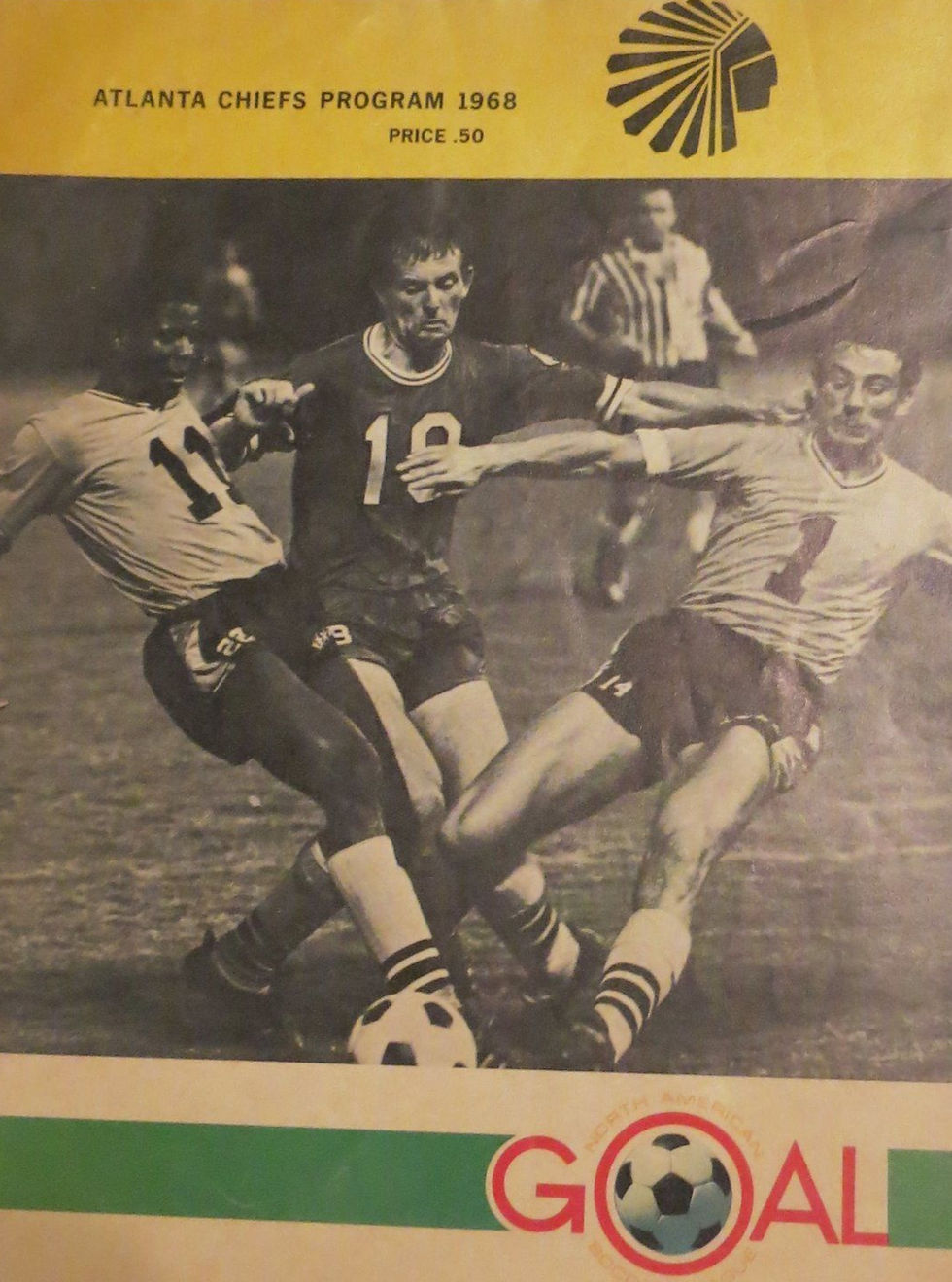
The 1968 season is the centerpiece of the Atlanta Chiefs story and one of the most consequential years in the history of soccer in the American South.
Woosnam built on the 1967 roster with an eye toward genuine contention. The team barnstormed the state in the preseason, running clinics in Columbus, Macon, LaGrange, Rome, and Athens alongside preseason matches. By the time the regular season arrived, the Chiefs were ready to compete. They were also ready for two moments that summer that put Atlanta soccer on the global map.
In June, English First Division champions Manchester City came to Atlanta for two matches. The Chiefs won both. Beating the reigning English league champions was not a small thing, and the wins traveled well in soccer circles. The second major event came later in the summer when Santos visited Atlanta Stadium with Pelé. A crowd of 28,000 came through the gates, a record for a soccer match involving an Atlanta team that stood until Atlanta United opened their first MLS season in 2017. The Chiefs were overrun that night by a Pelé hat trick that reminded everyone in the building why no one in the world could hold him when he was running. But the city had met global soccer, and the meeting mattered.

The 1968 championship team is documented in a photograph whose caption reads like the names of an entire era: Coach Phil Woosnam, Willie McIntosh, Gordon Ferry, Willie Evans, Vic Crowe, Delroy Scott, Kaizer "Boy-Boy" Motaung, Graham Newton, John Cocking, Peter McParland, Vic Rouse, Emment Kapengwe, Ray Bloomfield, Brian Hughes, Allan Cole, Everald Cummings, Freddie Mwila, and Sven Lindberg. Scan that list and what you see is the quietly radical nature of what Woosnam and Cecil had built: Welsh and English professionals alongside Jamaicans, a South African, a Zambian, a Zimbabwean. This was the American South in 1968, and a professional sports team was fielding and photographing this roster as its champions.
The playoff run that year required a Kaizer Motaung golden goal in extra time to get past the Cleveland Stokers in the semifinals. The Chiefs then traveled to San Diego for the first leg of the final, played to a scoreless draw, and returned to Atlanta Stadium for the deciding match. They won 3-0. The 1968 NASL championship banner was the first professional sports title in Atlanta history.
Even as the celebration happened, the headlines surrounding it carried a familiar anxiety. Questions about whether the team and the league would survive to see 1969 ran alongside the coverage of the championship. They were not unfounded. The NASL contracted dramatically after that season, going from 17 clubs to five. The Chiefs were one of the five who survived, but the price was significant: Phil Woosnam went across the hall at Atlanta Stadium to the league office and took over as NASL commissioner. He would spend the rest of his professional life trying to build the sport at the national level. Atlanta had launched his career and he had launched Atlanta soccer. Now the city needed someone else to keep it going.
5. Planting Seeds That Would Outlast the Club: 1969 to 1971
Vic Crowe took over as head coach in 1969, inheriting a team that had won everything the year before and a league that had just lost three-quarters of its membership. His background was impeccable. A former Welsh international, he had been a key figure in the 1968 championship and understood the dual mission of the organization: compete on the field and grow the game off it.
Crowe's tenure stretched across three seasons, 1969, 1970, and part of 1971, and produced two NASL runners-up finishes. The Chiefs finished second in the table in 1969 and lost in the finals in 1971, which means that across their six-year run the original Atlanta Chiefs appeared in two NASL championship finals, and finished second in 1969 when there was not a final, and won one title. By any measure of on-field performance, this was a successful franchise.

The community program never stopped. Vic Rouse, who would eventually take over the head coaching role, spoke in February 1969 to an Atlanta Journal writer about what the Atlanta name meant in global soccer terms. His quote became the epigraph of this page: "When you say you're with Atlanta, then people know and understand. Atlanta is U.S. soccer to people around the world." Crowe had his own version of the same sentiment. He told Furman Bisher simply: "Atlanta is American soccer."
These were not press release lines. They were observations from men who traveled internationally and heard what people said when Atlanta came up. The city's early commitment to professional soccer, the 1968 championship, the Manchester City matches, the Pelé game, the clinic program that was literally reshaping the state's youth sports landscape: all of it had made Atlanta something identifiable in global soccer conversations at a moment when almost nothing else in American soccer was recognizable at all.
The 1970 season saw the Chiefs move from Atlanta Stadium to Tara Stadium in Clayton County, an attempt to cut costs during a period when the Braves were not in great financial shape and the soccer operation's losses were compounding. The move was a mistake in at least one dimension: Vic Rouse would later observe that playing at a smaller, outlying stadium sent the wrong message to the Atlanta audience, which associated major league sports with Atlanta Stadium and treated anything else as minor league by definition. The Chiefs returned to Atlanta Stadium for 1971, where Rouse guided them back to the NASL final.
Throughout these years, something compounding was happening beneath the surface of the attendance figures and the wins and losses. By the early 1970s, Georgia was seeing explosive growth in youth soccer participation. The state association, still in its early years, estimated 8,000 participants by 1968. That number was growing rapidly. High school programs that had not existed before the Chiefs arrived were now fielding teams and building schedules. The suburban families who had watched Chiefs players run clinics for their children were now running leagues of their own.
Two players from the original era deserve specific recognition for what they gave the city beyond the field.
Henry Largie, a Jamaican who was a regular on the Chiefs' rosters, made the decision that many players in those years ultimately faced: go back home or stay. Largie stayed. He coached generations of Atlanta players across the following decades, becoming one of the foundational figures in the city's grassroots soccer development and a direct human link between the Chiefs era and everything that came after.
Kaizer Motaung came from South Africa and fell deeply in love with Atlanta during his time with the Chiefs. When his playing days were done and he returned to Johannesburg, he founded a club and named it after the team that had shaped him. He used the Chiefs' name, the Chiefs' badge as a template for his own. The Kaizer Chiefs are today one of the largest and most supported football clubs on the African continent, with millions of supporters across South Africa. The DNA of the Atlanta Chiefs of 1968 lives inside that club.
Freddie Mwila came from Zambia. Emment Kapengwe, also from Zambia, was alongside him. The Chiefs had more African players on their roster than any other team in the NASL. In the American South in the late 1960s, these men were going out into communities, into schools, into parks, coaching children and introducing them to a game that has since become part of the fabric of Georgia life. The historical record has not given them adequate recognition for it.
6. The End and the Legacy: 1972
The 1972 season began with a January financial disclosure to Atlanta Braves stockholders that set the tone for everything that followed. Vice president Dick Cecil reported that the team had accumulated losses of just over one million dollars since its founding. In 1971 alone, the losses had been just over $100,000. Bartholomay acknowledged in his letter to stockholders that the NASL's long-term viability remained an open question. He was right to be uncertain about the league. He was correct that the soccer interest in Atlanta was genuine. But he was also running a baseball franchise that had its own financial pressures, and the math was becoming hard to ignore.
The team returned for 1972 anyway, with Vic Rouse back as head coach and a schedule of just seven home games at Atlanta Stadium. The reduced schedule reflected the league's continued instability: the NASL had trimmed from 24 games to 16 as part of its ongoing effort to make the economics survivable for its small number of remaining clubs.
The 1972 season brought one final moment of international significance, a friendly against Dynamo Moscow that gave Atlanta fans a glimpse of Soviet-era football before the curtain came down. Then, in October, a few months after the season ended, Dick Cecil made the announcement that had been coming for several years. The Atlanta Chiefs were disbanding. Total losses since the franchise launched came to $1.5 million. His parting words were precise and not entirely without pain: "We can no longer justify that kind of loss. The growth of local soccer interest has not been reflected in attendance at the Chiefs' games."
He was right. He was also measuring the wrong thing.
The growth of local soccer interest had not shown up in Chiefs attendance figures partly because a professional soccer league in the late 1960s and early 1970s was not yet a product that Atlanta's broader sports market was equipped to support at a financially sustainable level. The league structure was unstable, the competition for entertainment dollars was fierce, and the new baseball and football franchises were the primary sporting identity of a city that had only just acquired that identity. All of that is true.
But the growth that Cecil had seeded and watered and tended for six years was real and it was permanent. It was just in the schools. It was in the youth leagues. It was in the state association. It was in the coaches like Henry Largie who had decided Atlanta was where their lives belonged. It was in the thousands of kids who had learned the game from Chiefs players running clinics in church parking lots and school gymnasiums across the state. It was in Karl Johnson of Druid Hills High School, who told a reporter in 1972 that he had gotten interested in soccer when the Chiefs started playing and now played all year long and could not have done so five years earlier because the organized game simply had not existed. No one on Johnson's Druid Hills team in 1972, the reporter noted, could say they had played organized soccer for more than five years, because it had not existed in Atlanta before the Chiefs.
Within a few years of the Chiefs folding, an estimated 17,000 youth players were registered in Georgia. By today, Georgia Soccer counts approximately 135,000 participants.
Vic Crowe, who coached those playoff teams of 1969 and 1971 and went on to have a significant impact in Portland as the Timbers' head coach, left behind a quote that has stood the test of time. He had said it during his time in Atlanta. He would keep saying it afterwards. "Atlanta is American soccer."
Dick Cecil had built something that outlasted the losses. He would come back to try again. So would the name.
7. The Second Coming: 1978 to 1981
The story of the Atlanta Chiefs did not end in 1972. Dick Cecil watched the NASL's second growth period, driven by Pelé's arrival with the New York Cosmos in 1975 and the investment boom that followed, and believed that the seeds planted in the late 1960s might finally be ready to bloom at scale.
He partnered with Al Thornwell and convinced Braves owner Ted Turner to bankroll a return to professional soccer in Atlanta by purchasing the Colorado Caribous and bringing the Chiefs name back.
The second Atlanta Chiefs played from 1979 to 1981 and produced their own remarkable moments, including a franchise-record outdoor crowd of 14,437 at DeKalb Memorial Stadium and successful indoor seasons at The Omni. Their full story is told at the link below.
[Atlanta Chiefs 1978 to 1981: The Second Coming — link coming soon]
Page last updated: May 2026. This page is a living reference document and will be updated as additional research is completed. Sources include Jason Longshore's primary research archive drawn from the Atlanta Constitution, the Atlanta Journal, the Atlanta Daily World, and additional newspaper and document sources accessed via Newspapers.com and Emory University collections.
Part of the Soccer Down Here Soccer Reference Desk Atlanta soccer history cluster.


Comments