
The Long View: Breel Embolo’s Debut Showed What Atlanta United Is Becoming

Atlanta United out-shot the best attack in MLS by a wide margin in the first game it had ever played at Miami's new stadium, then fought to make sure that performance actually counted, through a debutant playing on fumes, a missed penalty answered by another, and a goalkeeper who refused to let the result slip away.
Before kickoff, Lionel Messi crossed the field to embrace Tata Martino. By the final whistle, it was Luis Suárez in his arms.
Martino spent the second half of 2023 and all of 2024 managing Inter Miami, helping build the foundation of the team Atlanta faced Saturday night. Now he was coaching against two of the players who defined that era. It had nothing to do with the 2-2 final result, but it was part of the storyline surrounding the night.
The match itself went somewhere less sentimental.

Quite a bit about it argued Atlanta could have won. Inter Miami came in with the most productive attack in MLS, 58 goals now, and finished with two against an Atlanta team that has spent much of the season near the bottom of the league in shot efficiency and goals scored. Atlanta out-shot Miami, put more attempts on target and, by most measures that describe the quality of the performance rather than simply the result, was the better team for long stretches.
And yet it still needed a debutant to play through exhaustion, a penalty decision to go its way and its goalkeeper to deny the best player in the building twice just to leave with a point.
That's not a contradiction. It's the whole match in miniature.
Atlanta created enough to win and still conceded twice against the league's best attack in situations that reflected problems seen throughout the season. It failed to convert a penalty that would have leveled the match, then earned another one anyway. A 2-2 draw against Miami reads like a good road result on paper. What happened was messier, more self-inflicted and more encouraging than the scoreline suggests.
The team that has struggled all year to turn good process into good results finally produced both. It still found a way to make getting there difficult.
The Numbers That Don't Need an Asterisk
Strip away the final score and the simplest number is shots. Atlanta, a team that has spent much of the season near the bottom of MLS in most offensive categories, out-shot Miami 15-11, held a 5-3 edge in shots on target and had 53 percent of the possession. That alone tells you plenty about how the match was played.
The expected goals numbers support the same idea, with one important caveat: Atlanta was awarded two penalties, which naturally pushed the total higher. The cleaner comparison came at halftime. With Miami leading 2-1, the broadcast's expected goals numbers had Atlanta ahead 0.96 to 0.26, all from open play.
That was one of Atlanta's best process performances of the season, against one of the toughest opponents it has faced.
Two Goals Conceded, One Familiar Problem
The frustrating part is how little of that process showed up on the scoreboard through the first half. Casemiro rose over his marker in the 32nd minute and headed a Messi corner into the far corner. It was another example of a vulnerability Atlanta has dealt with throughout the season: defending crosses and aerial chances inside its own box. The numbers suggest opponents have consistently been able to generate danger from set pieces, and it showed up again against the best team Atlanta has played all year.
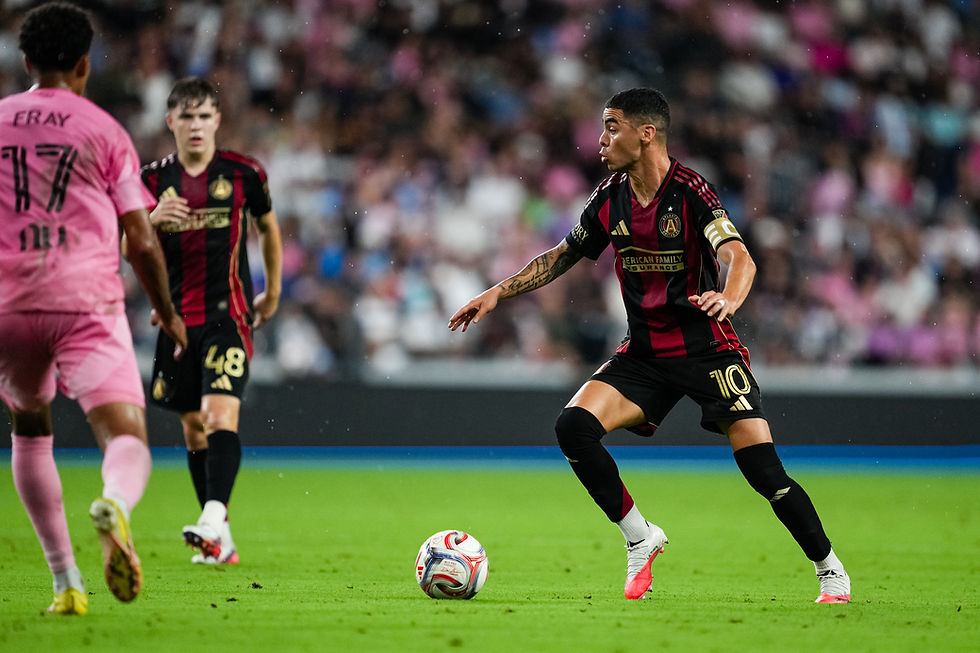
Atlanta answered 3 minutes later. Tomás Jacob's cross deflected off Casemiro, then goalkeeper Dayne St. Clair, before falling into the path of Miguel Almirón, who finished on the back post to level it at 1-1, a goal that seemed like it would settle the team for the rest of the half.
It did not last. Miami scored again in first-half stoppage time after Paulo Díaz lunged forward but failed to cut out the initial pass. Luis Suárez attacked the space behind him, took his first touch around Júnior Alonso as he tried to close, and slotted the finish past Lucas Hoyos to make it 2-1 at the break.
Miami had built a lead on individual quality rather than sustained control. Atlanta went into the locker room having generated nearly four times Miami's expected goals in the opening 45 minutes, and trailing anyway.
Martino agreed afterward: "I don't think we made many mistakes in control of the ball. In the second half we were better, aside from those final five minutes when we dropped back. I think we did enough to earn the draw, and maybe we could have won it too."
Called Before Kickoff, Confirmed at the Half
Before kickoff, I said on the air what Atlanta needed to do. "Atlanta needs to find a way to make Casemiro defend as a center back, because he's not one. Make Falcón be disciplined, because he's not." Walking into the second half, with Falcón and Cooper Sanchez both already on yellow cards, I made the same point in real time, flagging Casemiro again in the same breath as the player who'd just scored Miami's opener. "That is one that is concerning, if you're Miami, to the point you might be looking to make a change on that back line. You also have to look at Casemiro on that back line. He's not a traditional center back, so that is another liability."
This was the matchup Atlanta needed to exploit, and by full time it had, in two related but distinct ways. Casemiro's part played out almost exactly as flagged: the same player who had just scored Miami's opener fouled Almirón in the box for the first penalty less than 40 minutes later. Fricio Caicedo's is a looser confirmation. Falcón came off at halftime, and Caicedo, an 18-year-old fielded on the left to open the match, slid inside to the center back spot Guillermo Hoyos said afterward is actually his natural one, and it was there he conceded the second penalty. That's a back line reshuffled under pressure giving something up, not quite the same mobility problem flagged before kickoff, but it still came from the area of Miami’s back line Atlanta had targeted.
A Debut That Wasn't Supposed to Look Like This

Atlanta's own defining moment of the second half went the wrong way first. Casemiro brought down Almirón in the box in the 70th minute, VAR confirmed the penalty a minute later, and Casemiro was booked for the foul. Almirón, the designated penalty taker, stepped up in the 73rd and saw it saved low to his right by Dayne St. Clair. Almirón called the response plainly: "The team really showed a lot of personality to be able to come back in the match and grab an important point." Martino used a more guarded word for the same idea. "I don't know if the character is changing, because I don't like comparing eras I wasn't part of," he said. "What I do know is that tonight we had character."
The clearest evidence of it wore Embolo's number. At halftime, still not sure how much he had left, I said on the air I didn't know how long he could play. Martino confirmed afterward that the plan had never been for him to play the full 90. "He played the entire match, all ninety minutes," Martino said. "Normally he should have been a player who could give us sixty, sixty five minutes, because he's just arrived. This week he finished his visa paperwork in Canada." Instead Embolo played the whole game, took a touch in the box in the 87th, and was hauled down after a ball in from Fafa Picault, winning and converting the penalty himself. "He had a lot of bravery, a lot of courage to get through ninety minutes," Martino said, "and on top of that to score the equalizing goal, when the penalty was committed against him."
Guillermo Hoyos Wanted a Different Argument
Miami's side of that penalty was not settled by full time. Guillermo Hoyos, the interim manager who will soon be replaced by the incoming Kily González, disputed the call directly. "We didn't see that it was a penalty," he said. "The team had the match under control, and when they call a penalty that isn't one, it takes you out of your rhythm, it knocks you out of position. For me it was unjust."
Personally, I felt like the shirt grab was enough to give the penalty. We see that sort of call go both ways. But for an Atlanta team that had not earned any penalties, despite some strong cases for them at various points, to earn two penalties in one half on the road was quite unexpected. Both decisions from the referee Jon Freemon were justifiable. The rest of Hoyos's timeline is important. By his account, Atlanta had the run of play for 20 to 30 minutes before the penalty ever happened, which makes the idea that the call knocked Miami out of its rhythm hard to square with a rhythm the team had reportedly already lost.
Lucas Hoyos Made Sure the Numbers Meant Something

The margin between a hard-fought point and a demoralizing loss came down to a chaotic stretch of stoppage time, and to a goalkeeper who has taken more criticism from this fanbase than his season has probably deserved. A blocked shot fell loose to Messi inside the box, and Hoyos saved it with his outstretched left foot. The rebound bounced back to Messi, and Junior Alonso threw himself in front of the second effort to force a corner. Miami kept coming. Deep into 8 minutes of stoppage time, Messi went for the near post directly off a corner kick, an Olimpico, aimed directly at goal with no intention of anyone else touching it. "Messi's going Olimpico at the near post, which is borderline impossible for any human, and he almost pulled it off," I said on the broadcast. Hoyos punched it away, punched away the corner that followed too, and the ball was cleared off the line. Miami came forward once more, a cross found Germán Berterame but his header went over the bar from close range.
These are the kinds of moments that do not effectively show up on stat sheets, on spreadsheets, or in xG models. The sequence itself is important to note: the reaction saves and punches from Hoyos, Alonso's block and screaming afterwards that irked Messi, the traffic in the box, Miranchuk chasing down a loose ball in his own half. All of it was the difference between a hard-earned point and a result that would have obscured everything Atlanta had done well.
Progress, Not Proof
Atlanta is still outside of the playoff spots in the Eastern Conference, currently sitting in fourteenth place and five points behind the final team in the play-in round. This was a point earned though. More importantly, Atlanta increasingly looks like a team evolving in front of us with the additions of Embolo and Mauricio Amaro, and the soon-to-debut Giuliano Galoppo.

Only considering the scoreline in Miami undersells the performance badly. Atlanta played one of its best halves of soccer this season after the break and did it in ways that mattered beyond possession or shot totals. Breel Embolo pushed through far more minutes than expected in his debut and still had enough left to win and convert the equalizing penalty. Mauricio Amaro's introduction gave Atlanta more quality on the ball and more bite in winning it back. And in the final moments, when Miami threw everything forward, Atlanta showed the kind of resolve that has too often been missing this season.
It still conceded from an area of the field that has caused problems all year. It still needed Lucas Hoyos to preserve the point. But on the road against the league's most dangerous attack, and against the club Tata Martino helped build, Atlanta found a way to keep playing, keep responding and leave with something its performance deserved.
What I said on the air after the final whistle still holds up watching it back. This team is finding an edge, a resolve, a fight over the last several weeks that wasn't there in the spring. It has continued to be willing to keep playing the way Martino demands even when the run of play refuses to reward it.
A draw on the road against the league’s best attacking team, produced by out-shooting it comfortably, doesn't prove Atlanta has solved what's gone wrong this season. It does provide meaningful evidence that the improvement of the last several weeks is real, and that it can hold up against the toughest test this team has faced all year.
Part of that is personnel. The additions Chris Henderson has helped bring into the club have made this a more talented group, and the personality of that group is beginning to take shape. Embolo is only just arriving. Amaro is still settling in. Other new faces are still learning one another, and the chemistry that comes with time is only beginning to develop.
None of that guarantees Atlanta reaches the playoffs this season. There is too much ground to make up, and too much of the season already gone, for one strong performance to erase what came before it.
But it does make it reasonable to feel better about where this is headed.
This is not the finished version of Atlanta United. It is a more talented one, a more connected one, and increasingly a version worth trusting more than the standings currently suggest.


Comments