
The Long View: Miranchuk's Map

Atlanta controlled less of the game than the scoreline suggests. What they controlled was the right part of it.
Before the first ball was kicked Saturday night, the tactical shape of the match was already clear. Montréal under interim head coach Philippe Eullaffroy had simplified considerably from what Marco Donadel was attempting earlier in the season. The idea was pragmatic: sit compact, surrender possession voluntarily, defend with numbers, and punish Atlanta in transition. From the booth, I knew exactly what the night's central variable would be. Neither team had gotten a result when failing to score first this season. The opening goal was going to carry emotional weight well beyond its face value.
That framing survived exactly six minutes.
Matty Longstaff's goal came from a slow Atlanta buildup that invited Montréal forward. The pace out of the back was poor, Enea Mihaj had limited options but not enough urgency to clear his lines, and Montréal converted the transition moment their entire structure had been built to create. Atlanta had fallen directly into the game Montréal wanted.
What happened next is what this match was actually about.
The Game Montréal Wanted and Didn't Get to Keep
The surface statistics from this match are genuinely misleading. Montréal generated 61 open-play progressive passes to Atlanta's 51. Progressive passes are exactly what they sound like, passes that move the ball meaningfully toward the opponent's goal, and Montréal making more of them than Atlanta suggests a team that was, at least by that measure, pushing the game forward more consistently. They were caught offside eight times, the fingerprint of a front line timing runs behind the defense and getting there too early. The PPDA figures were nearly identical on both sides. PPDA measures how many passes a team allows per defensive action, and when the numbers are this close, neither team is pressing the other into submission. A surface read says competitive match that could have gone either way.
What the numbers don't say is that Montréal were specifically designed to produce that kind of volume without converting it. Their progressive passes came predominantly down the flanks, Luca Petrasso with 11 from the left and Dawid Bugaj with 10 from the right, but the end product in dangerous central zones was thin. Zone 14 is the central area just outside the opponent's penalty box, the corridor where the most dangerous chances are created, and their half-spaces are the channels on either side of it. Montréal's 13 passes from those areas produced just 1 key pass and 1 assist all night.
Prince Owusu was their highest xG generator at 0.46. Expected goals measures the quality of a chance based on where the shot came from and how it was created, and Owusu's number says he was getting into promising positions. He also committed 4 fouls and completed passes at just 73 percent, spending as much of the match fighting for possession as using it. Iván Jaime had moments of individual quality but couldn't sustain pressure into sequences. Montréal were moving the ball into positions that never led to danger being created.
In the early going, with Atlanta slow and Montréal organized, that structure was working. Calling it from the booth, I kept waiting for Atlanta to quicken the tempo and they couldn't find it. Around the 20-minute mark things began to shift. Pedro Amador started winning balls. The buildup started moving Montréal rather than playing into them. By halftime, Montréal had stopped getting the game state they'd been designed for.
Miranchuk's Zone and What Martino Designed
Alexey Miranchuk finished the match as Atlanta's leading chance-creator with 5 chances created. He accounted for 9 of Atlanta's 27 total Zone 14 and half-space passes, 6 of those initiated from Zone 14 itself. Both assists came from that central corridor.
Martino had designed this specifically. He told reporters afterward that his preparation identified something in Montréal's defensive shape: their center backs were inclined to step out and mark Atlanta's interior midfielders, which left a center back alone against the center forward. "We wanted to try and have Manu take advantage of that one-on-one matchup," he said. Emmanuel Latte Lath's physicality was the intended tool. The plan held through the first half.

What made Miranchuk so difficult to handle was the manner of his movement. He doesn't arrive in dangerous spaces at pace or with obvious intent. He drifts into pockets, and by the time a defender identifies the problem, the ball is already with him. I said on the broadcast that the comparison that came to mind was stylistic, not talent-based: the way Messi finds space, not at speed but by being somewhere a defender didn't account for until it was too late. Miranchuk operates the same way. His average position stayed central regardless of his nominal role all night.
At halftime, Miranchuk was visibly vocal and animated in a way I hadn't seen as much before. He was wearing the captain's armband, and the weight of that was clearly landing. The performance was already providing the answer. The halftime demeanor showed he understood his job in providing it.
When Latte Lath tired in the second half, Martino adjusted, dropping Miranchuk deeper into the center forward role to restore midfield numbers. "I noticed that he was getting a bit tired," Martino said, "so we made the switch to play Alexey in that position to give us more of a numbers advantage in that part of the field." It also freed Tomás Jacob space on the right side and kept Miranchuk in the exact zones he'd been operating from all night anyway.
The Two Goals That Changed More Than the Score

Saba Lobjanidze's equalizer in the 41st minute arrived through the central combination the first half had been slowly building toward. Miranchuk's movement with Pedro Amador through the middle, Lobjanidze cutting across the face of goal on his right foot and shooting back against the goalkeeper's momentum. Atlanta supporters have seen that finish from him before.
The larger point was what the goal meant for the player. Lobjanidze needed that moment. He hadn't had many of them this season, and it carried the weight of a confidence event as much as a tactical one. His xG for the match reached 0.9 from 5 shots, both goals coming from inside the box on the left side. That's the quality of chance that reflects genuine positioning intelligence, not volume.
"He knows my game, I know his game," Lobjanidze said of Miranchuk on the Full Time Report heard on 92.9 The Game. "We are trying to use each other."
The shot map shows exactly how that use materializes. Both finishes came from the left half-space, the territory Miranchuk's Zone 14 activity opens by forcing defenders into decisions they can't resolve cleanly.
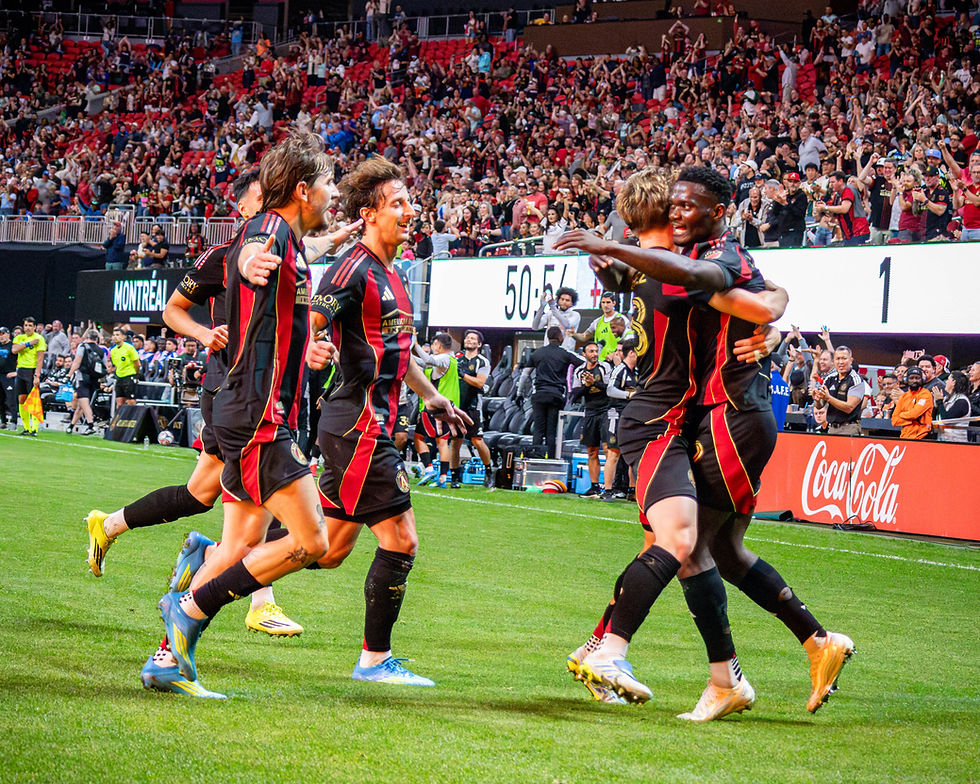
Latte Lath's goal in first-half stoppage time, also assisted by Miranchuk, changed the emotional temperature of the entire match. Players ran from the bench to reach him. Latte Lath noticed it.
"Everybody came to hug me because they know it meant a lot," he said on the Full Time Report heard on 92.9 The Game. "Maybe they saw me a bit frustrated. That's really good for a team, to see a player really, really happy."
Martino had started both of them with a specific intention: closing the circle on a week that included wins in Toronto and Charlotte. "Not even when I was planning the game did I think we would have a result like that," he said.
How the Third Goal Got Scored
Cooper Sanchez identified a Montréal fullback moving inside, recognized that fullbacks are uncomfortable in that position, pressed him, won the ball, and found Lobjanidze.
He described it simply on the Full Time Report heard on 92.9 The Game: "Their fullback coming inside, fullbacks aren't naturally comfortable there, so they're more prone to mistakes. I decided to go press him, won the ball, played Saba, and easy goal."
Sanchez is 18 years old and playing his most consistent football of the season. He completed 49 passes at 90 percent accuracy. Tristan Muyumba alongside him completed 59 at 92 percent. Together they gave Atlanta the circulation platform that made everything Miranchuk did in Zone 14 possible.
Martino was direct in his praise for Sanchez:
"His ceiling is very hard to see, it's as high as he sets it for himself, because he handles every register you need from a box-to-box midfielder. He's dynamic, he's intense pressing and winning the ball, he makes deep runs of real quality, he handles the ball well, he understands the game. And now he's adding assists and goals. Nothing that's happening to him is surprising or undeserved, because of how he works during the week."

Then, after a pause: "And he's only 18 years old. That is a rare thing to find at
that age."
Martino also pointed to the third goal specifically as evidence of something he's been trying to develop. "It's something we haven't been able to implement as well as I would like," he said of the high press that produced it. "But to see us do that, to be able to put the score in a more calm position for us, is a good sign."
The Response Win
Martino opened his post-match press conference by being asked about two statistics. The first, that this was Atlanta's first three-match winning streak since 2021, Martino dismissed as irrelevant. The second, that this was the first time in seven attempts in league play this season Atlanta had come from behind to win, he treated as genuinely meaningful.
"We've seen at different games this season where we haven't been able to do that, where we've gotten desperate and disorganized," he said. "The fact that we're able to do it now, I think that is relevant."
He's right.
The sequence Saturday night was not clean. Atlanta built too slowly in the opening minutes, gave Montréal exactly the transition opportunity they were designed to exploit, went down 1-0 inside six minutes, and spent the next 15 minutes unable to find the tempo Montréal was working hard to deny. Earlier in the season, that Atlanta team might have gotten desperate, started trying individually to solve a collective problem, and fallen further behind.
Instead, they wobbled, found their footing around the 20-minute mark, and scored three goals in a 10-minute window straddling halftime. Mihaj led the team with 83 touches and 70 passes as the anchor throughout. The defensive structure held: 131 total defensive actions through the spine of the pitch, shape maintained even when Montréal pushed.
The system still has room to grow. Atlanta's final-third decision-making in crowded areas remains inconsistent, the difference between a chance created and a chance wasted often coming down to one extra touch or one pass choice that doesn't quite match the moment. Martino acknowledged it: "Not as well as I would like, but we're evolving."
But the mechanism is increasingly clear, and more importantly, the players inside it are starting to trust it. Build through the middle using Mihaj and the midfielders, find Miranchuk in Zone 14, get players like Lobjanidze and Latte Lath into the spaces his movement opens. When that chain executes, Atlanta score. And each time it executes, the belief that it will execute again grows a little stronger.
Montréal outprogressed Atlanta with the ball on Saturday night. They lost by two goals. The difference between those two facts is the whole story of what this team is learning to do, and for the first time in a while, they seem to know it.


Comments