
Training Ground Notebook: Three wins, real belief, and a Galaxy test waiting

Atlanta United's training ground had a different feel this week. The players sounded like it, Tata Martino sounded like it, and the conversations were less about fixing problems and more about sustaining something that is starting to work.
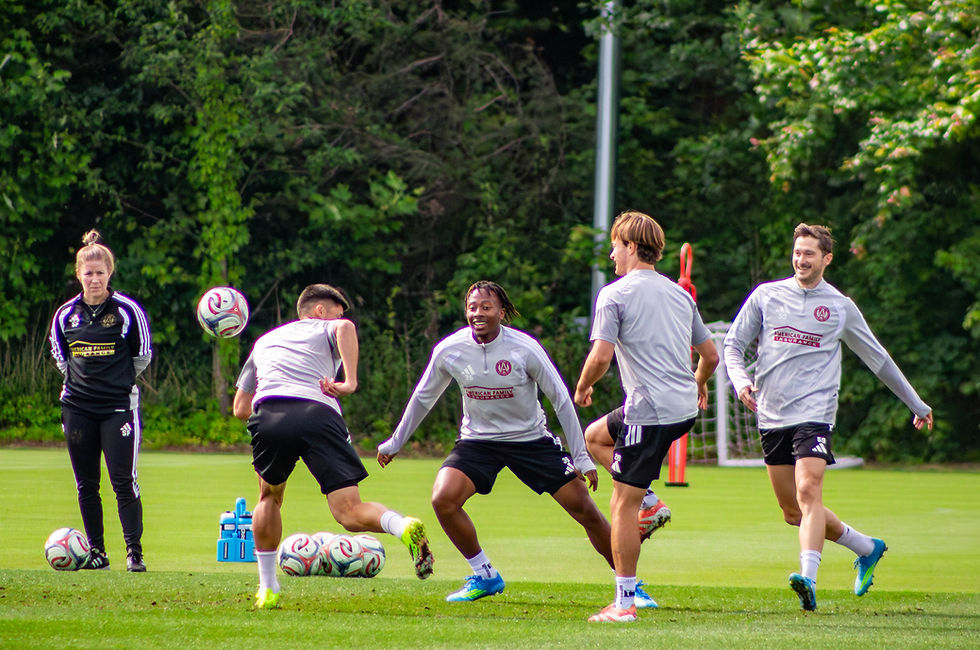
The three-game winning streak has changed the atmosphere inside the building, and nobody in Atlanta's media availability this week tried to downplay that. What made the conversations more interesting, though, was the way each person described what is actually driving it. This is not just a team that got hot. It is a team that had some hard internal conversations, made a collective decision to fight for each other, and is now watching that decision show up on the field.
Saturday against LA Galaxy will be the next measuring stick.
The vibe has genuinely shifted
The most consistent theme across every availability this week was simple: the environment inside the group is different now.
Stian Gregersen put it plainly on Friday.
"The atmosphere has been fantastic," he said. "And of course the energy, and of course it is helping to win games."
That is the kind of thing players say when things are going well, but the details underneath it carried more weight. Gregersen talked about the team working in the same direction, about everybody contributing to the current run, and about what it has meant to rotate the full squad through the U.S. Open Cup while keeping the older players healthy in a tight schedule.
Matt Edwards was even more direct on Wednesday about what drove the shift. "We've had meetings as a team and really knocked out what the problems are and how we can fix them," he said. "To start off with mentality, that's a big shift I think I've seen from the group." He described what those early losing stretches actually felt like from the inside: "You feel like you don't know what to do at times. You're not confident. You feel like a loser." That honesty made the turnaround feel more real. This group did not drift into form. It chose to change.
Edwards also connected the three-win run to its variety. Toronto was gritty and physical. Charlotte was controlled. The home game against the last opponent required a comeback. "Each game is different," he said. "We have to approach each game differently, but they all require a strong mentality, and that's one thing that we can control."
I asked him back in preseason what word he wanted to define this team in 2026. His answer was nasty. Asked this week if that is starting to show, he did not hesitate.
"All of us are looking at each other in the eye like, alright, let's fight for each other. We realized that the only way this gets solved is if we fight for each other and we die for each other on the field. That's the biggest shift for sure."
Alexey Miranchuk is driving this team
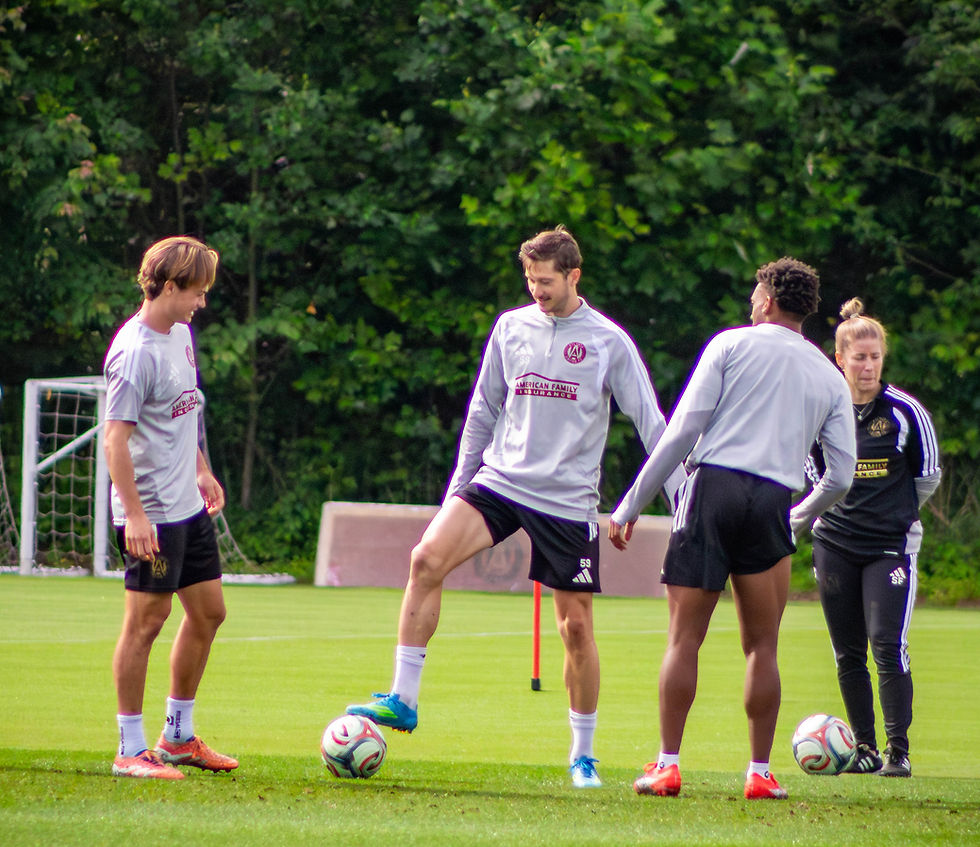
The richest thread of the week ran through all four availabilities, and it all pointed in the same direction.
Alexey Miranchuk is not just playing well. He is becoming something more. He is playing multiple positions for this team right now, serving as its captain on the pitch, and becoming a leader in important ways.
Tata Martino said on Friday that Miranchuk is giving the team everything they expected from him.
"He has a great commitment to the team, to how the team functions, to the impact he has within the team," Martino said. "And right now he is carrying us forward, at least from my perspective, in the way we expected."
Gregersen was even more pointed. "Now we really see who Alexey Miranchuk is," he said. "I can see he takes more responsibility. He talks to people, and also on the pitch you can see his confidence is a little bit different. He has scored. He has been so fantastic."
Edwards confirmed what Miranchuk is doing away from the ball too. The pregame speeches. The emotional investment in the locker room. "At times we didn't see that of Alexey," Edwards said, "and he showed a lot of emotion recently and brought us together as a group." He added that Miranchuk has become more vocal on the field as well, something the group has responded to. "Everyone respects Alexey, so it helps."
Miranchuk himself, when asked about the pregame speeches, was characteristically understated about it, but honest. "As you know, I'm not really the person who speaks a lot, who is aggressive and all of those kinds of things," he said, "but I think I caught myself getting there. I'm getting there, and I start to push myself to say something in the locker room, in the meetings as well, just to give the players courage."
He was also thoughtful when asked whether the confidence on the field is feeding the leadership off it, or the other way around. "Both, on and off the pitch," he said. "I'm quite an experienced player. I thought it would be good to say something for the young players and give them confidence and courage."
The captaincy has clearly unlocked something in him. He acknowledged as much himself, saying that wearing the armband has made him feel like he needs to speak before games. He also said something worth noting about Miguel Almirón: "Hopefully he can come back soon and lead the team." That is the comment of a player who understands the role he is filling and is not trying to claim it permanently. He is holding something for someone else while carrying the group forward.
Martino was asked about the importance of Saba Lobjanidze and Emmanuel Latte Lath both scoring in the last match, and his answer connected directly to Miranchuk's broader impact on the group.
"We had been showing improvement in our play, and then improvement in our results as well," he said. "Two of our forwards scored goals, we won because of their goals, and it is good for their confidence and good for the team's footballing growth. It brings a lot of calm."
Cooper Sanchez at 17, and the group that is protecting him
One of the more revealing moments of Friday's availability came when Nate Bukaty from Apple TV asked Tata about Cooper Sanchez, noting that there had been some surprise when the 18-year-old appeared in the starting lineup earlier this season.
Martino's answer was thorough and genuine. "In general terms, I see things in him that you see in a player over 20 years old, with more experience, more games, a different age, a different maturity," he said. "Everything I find in him are very important characteristics for a midfielder, but you very rarely see them in a 17 or 18-year-old."
What made the answer especially useful was the distinction Martino drew about what makes Sanchez different. It is not just bravery, though he has plenty of that. "I'm not only talking about the composure to play, the bravery to play," Martino said. "I'm also talking about the capacity he has to understand the game." At 18, that combination is genuinely rare.
Gregersen, who has watched Sanchez up close every day in training, landed on the same thing from a different angle.
"Cooper is so fantastic to see," he said. "He's just smiling, enjoying his life, you know, and he's not scared. He just enjoys to play football, and that helps also with his performance."

Martino also addressed what has made Sanchez's integration into the group so smooth. "When a player plays well, his integration into the squad is much easier," he said. "And since he plays very well, the group has fully integrated him. Not only has it integrated him, it has protected him." That last detail, the group actively protecting a teenager, says something real about where this locker room is right now.
Edwards connected that to the broader homegrown dynamic, noting that the academy core, himself, Sanchez, and others, brings a sense of ownership to the environment.
"You feel more at home, and you feel like this is your team when you're coming from the academy and you're homegrown," he said. "We've been a part of this team sometimes for a lot longer than the other guys."
Tata on positional play, partnerships, and what he is willing to give up
The most tactically revealing moment of Friday's availability came from the last question of the session.
When I asked him how he balances Atlanta's positional structure with the individual partnerships and on-field relationships that seem to be driving the team right now, Martino gave an answer that was worth paying close attention to:
"If I had to give something up for the sake of something I'm seeing from the team that I like, I give up the structural part," he said. "If there is a partnership I see that is working, a sector of the team that is combining well, and I need to preserve that even at the cost of a positional element of the team, I am going to do it."
He went further. "What we coaches value most are individual moments, collective moments. We value areas of the field where the team expresses itself with great clarity. And when that is achieved, I am willing to give up positional matters, or even a change of shape, in order to preserve those partnerships on the field, because they are working well."
That is a meaningful admission from a coach whose teams are known for positional discipline and structure. It suggests Martino is watching this group closely enough to let what is happening on the field shape his decisions, rather than forcing the team into a fixed frame. Three wins in a row has a way of clarifying what is worth protecting.
What LA Galaxy brings, and what Atlanta has to solve
Martino was direct about the challenge Saturday's opponent presents.
"Galaxy has attacking players who are very unbalancing," he said. "Being able to neutralize players like Gabriel Pec, Joseph Paintsil, and Lucas Sanabria, who create imbalance and who do a lot of damage in space, that is where we are going to have to be very careful, especially to avoid losing the ball at inopportune moments."
Gregersen echoed the defensive approach Atlanta wants to bring. The back line has been operating with an aggressive, high-line mentality, staying on their toes rather than dropping, pressing rather than retreating.
"We have to be on the front foot," Gregersen said, "to not get this transition against us."
Against three forwards who can hurt you in the space behind a high line, that is going to require the same sharp collective defending Atlanta showed over the last three matches.
Miranchuk, asked about what needs to keep improving regardless of the winning streak, was blunt. "We have to maintain the intensity and the aggressiveness on the field," he said. "Because we have a lot of quality players in natural quality. We just have to maintain aggressiveness, and quality will come later."
That is the balance Atlanta has to strike on Saturday. The relationships are working. The mentality has shifted. The confidence is real. Now it has to hold up against a Galaxy team built to unsettle exactly the kind of aggressive, high-energy defending that has been Atlanta's calling card through this run.
Three wins in a row raised the bar. LA Galaxy is a test of whether Atlanta can clear it.


Comments