
Atlanta's NWSL Team Is Being Built With Purpose

Josh Blank laid out the timeline for Atlanta's 2028 NWSL launch. The organization is not waiting for opening day to figure out who this club is supposed to be.
Atlanta's NWSL team does not have a name yet. The crest, the logo, and the coach are all still to come. The chief soccer officer search is underway and the roster has not been assembled. From the outside, 2028 feels a long way off.
From the inside, the work is already well underway.

Josh Blank, Vice President of Executive Strategy for AMBSE, sat down Monday for a roundtable with the Arthur M. Blank Foundation and laid out a build that is moving with real intention. Hires are being made. The training facility is in the ground. Fan research is done. The brand reveal is coming this fall. The people running this launch are not waiting for opening day to figure out who this club is supposed to be.
They are also entering a league that barely resembles what it was when AMBSE first started evaluating it years ago.
The NWSL in 2026 is a fundamentally different property. The TV deal that was barely worth mentioning a few seasons ago was replaced by a four-year agreement covering CBS Sports, ESPN, Prime Video, ION, and Victory+, a streaming partnership that launched this season. The league grew from 12 teams to 16 in 2026, adding Denver Summit and Boston Legacy, with Atlanta announced as the 17th franchise and Columbus just confirmed as the 18th. Commissioner Jessica Berman hired a new chief commercial officer and chief marketing officer last month to keep pace with what the league has become. The 2026 season opened with a crowd of 63,004 for Denver Summit's first home match at Empower Field at Mile High.
The money tells the same story. Forbes valued the Kansas City Current at $325 million in April, making it the second-most valuable NWSL franchise behind Angel City FC at $340 million. Five years ago, the average NWSL team was worth under $20 million. That average is now $134 million. The expansion fee for Atlanta's franchise was $165 million, according to reports. In 2020, Angel City paid $2 million for the same right.
The broader market is moving in the same direction. McKinsey projects the U.S. women's sports market will grow at 16% annually, roughly three times faster than men's sports, reaching around $2.5 billion in annual revenue for rights holders by 2030. Corporate sponsorship spending across the WNBA and NWSL jumped 32.7% year-on-year to a record $195 million in 2025, per SponsorUnited. Global women's sports revenues are on pace to exceed $3 billion this year, according to Deloitte. The infrastructure is catching up to the demand, and the demand keeps growing.
Atlanta is not jumping into an unproven bet. They are joining a league on the rise and building for it accordingly.
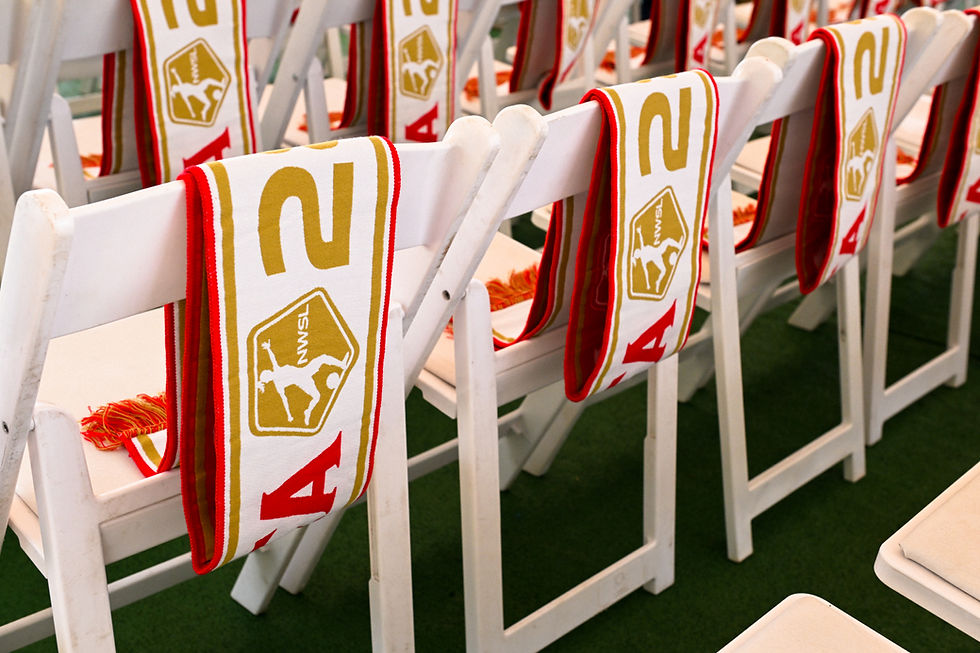
Mauricio Culebro is on board as president for both the NWSL team and Atlanta United. Deandra Duggans, formerly of the Las Vegas Aces, was announced as chief business officer a few weeks ago. According to Blank, a CFO is expected this week. The chief soccer officer search runs through the summer, with the goal of having someone in place by the time the World Cup wraps. Once that person is seated, the coaching search and roster-building begin. The target is a substantial front office in place by the end of 2026, with significantly more staff coming on in early 2027.
The training facility groundbreaking is already done, and the design is future-proofed from day one, with locker rooms planned for an eventual academy. That kind of long-range thinking does not happen when an organization is just trying to get a team on the field. The facility will also serve as a primary recruiting pitch: come train at an $85 million facility, play in one of the best stadiums in the world, and build your brand in a city with real global ambition.
The brand identity arrives this fall. Name, crest, and logo, all unveiled before the year is out, which gives the club a full 2027 to build momentum before the first whistle. Every month the badge is out in the world before opening day is a month of equity the club does not have to earn from scratch once the season starts. Atlanta United proved that fandom, given room to grow ahead of launch, can arrive ready.
The Georgia pipeline is already there. Twenty-one players from Georgia are currently in the NWSL, the fourth-highest total of any state in the country. Blank wants that to be part of the club's identity in a real way, not a recruiting footnote. The long-term goal is a roster with genuine Georgia roots, players who grew up in this soccer ecosystem and want to come back to it at the highest level.

The fan research is done too. AMBSE surveyed its founding NWSL members and a broader Mercedes Benz Stadium database to understand how people want this team to take shape. The playing identity that came back will feel familiar to Atlanta supporters: attacking, expressive, worth showing up for regardless of the scoreline. Blank referenced Darren Eales' early framing that he would rather play a 4-3 match than win 1-0. That identity is already part of the blueprint.
Women's soccer does offer a dimension the men's game does not, and Blank was direct about it. "Women's players tend to have a little bit higher propensity to feel more comfortable in front of the camera," he said. "So how do we lean into them wanting to build their (own) brands more?" The NWSL is betting on the same thing at the league level, hiring Rachel Epstein as chief marketing officer last month with an explicit mandate to amplify player stories and deepen fan connection. The club is treating that as an asset rather than a variable to manage. The intent is to let players define who this team is, not hand them a mold and ask them to fit it.
Knowing who you want to be is the easy part. Building the organization that can sustain it is where expansion clubs typically struggle.
Atlanta United is the evidence. The MLS expansion side launched in 2017 with a lean, fast model: a small dedicated core, heavy reliance on the broader AMBSE shared services ecosystem, and a bet that sporting identity would carry everything else. It worked spectacularly in the early years. What it also produced was an organization that had to figure out, on the fly, how to transition from expansion team to established club without losing who it was.
Blank was direct about the organizational lesson. Replicating the United model and expecting the same results was not something he believed was possible. "So in this case," he said, "we are hiring a lot more NWSL-specific individuals from the outset."
That lesson is baked into the NWSL build from the start. More dedicated hires earlier. Infrastructure designed for what the club will eventually need, not just what it needs on day one.
The brand timeline is not an accident. The sequence is intentional. Every significant announcement between now and the first whistle, signings, hires, facility milestones, will carry the name and badge with it. The identity does not form on opening day. It forms in the months leading up to it, attached to real moments that give fans something to connect to before a ball is kicked.
The goal was never to recreate 2017. As Blank framed it, the ambition is to build something that survives its own honeymoon, in a league that no longer needs to be explained to anyone.
That is a different ambition. And right now, they are building toward it the right way.


Comments