
The Living Room on Broad Street

On the same street where Atlanta first talked about soccer, the game is back home
The taps went in last week. The TVs are going up. This morning, the doors at 91 Broad Street Southwest open for good.

Humberto Bermudez has been at this for months. Since around the first of the year, he has been equipping and accessorizing the new Broad Street location, the second home of the Brewhouse Café, whose original Little Five Points location Men in Blazers named the best soccer bar in the United States. The new spot quietly opened its doors on June 15, the day Spain and Cabo Verde played Atlanta's first ever World Cup match a 15-minute walk away. Today, June 17, is the official grand opening.
"We're coming to the 'end,' and we're coming to the 'beginning' of the World Cup and the beginning of a new era in south downtown," Bermudez told WSB-TV last week.
The people who know the Brewhouse best already know what makes it what it is. "This is a really great place for a sense of community," longtime patron Hannah White said. "If you want to watch soccer, this is the ideal spot in the area."
Bermudez is right about the end and the beginning. He is also more right than he knows about what this street has seen before.
Broad Street runs from its northern end near Peachtree, angling south past Five Points, through the heart of South Downtown and down toward Martin Luther King Jr. Drive. It has been a commercial corridor since Atlanta's earliest days, home at various points to department stores and banks and barbershops and one of the city's most celebrated hotels. By the year 2010, according to an Atlanta Police Department captain, it had more homicides on a single stretch than any other street in the city. The buildings that now surround the Brewhouse were so forgotten for so long that they were, as Jon Birdsong wrote after buying them, "forgotten to be torn down."
What almost nobody knows is that Broad Street is also where Atlanta first talked about soccer.
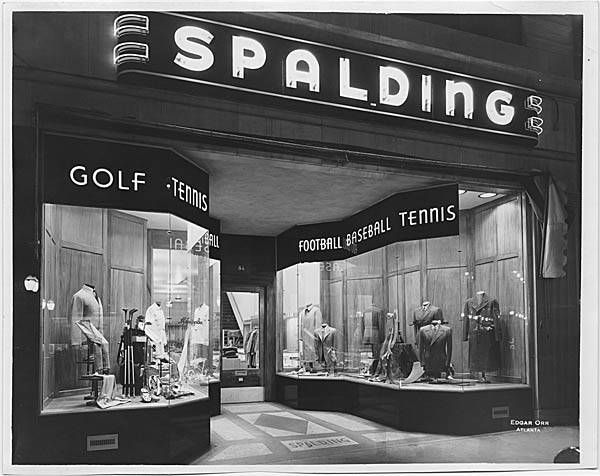
Not metaphorically. Literally. On a Thursday evening in October 1913, a group of men gathered at a sporting goods store at 74 North Broad Street to organize the first soccer league in the city's history. They met there again the following Thursday. And the Thursday after that. They kept meeting on Broad Street, month after month, through two full seasons, until the war came and took the players away.
When the players came back, they returned to the same building on the same street.
The building is gone now. A Georgia State University classroom opened on the site in 2002, after a demolition that drew public protest. But the street is still there. And on June 15, 2026, Atlanta soccer's newest living room opens its doors at its southern end, right in the middle of the line between where the game's first conversations happened and where its biggest moment yet will be played.
The sporting goods firm of A.G. Spalding & Bros. opened its Atlanta branch in October 1908 at 74 North Broad Street NW. The company was already the dominant infrastructure of American sport, having manufactured the official National League baseball, designed the world's first basketball, and published the official guides for virtually every organized sport in the country. The Atlanta store was its Southeast regional distribution hub, and it put Edward H. Worrell, described by the Atlanta Constitution as one of the best-known sporting goods men in the United States, in charge.
What followed over the next several years is documented in newspapers and in the pages of the Official Soccer Football Guide, the national publication the company produced through USSF co-founder Thomas W. Cahill. Soccer organizers in Atlanta had been meeting since at least 1908, first at the Eagles Club on North Pryor Street, then beginning in December 1911 at the Spalding store. The monthly Thursday evening meetings on North Broad Street became the organizing center of a sport that most Atlantans had never seen.
The people who gathered there knew they were a niche. The Atlanta Constitution, writing in 1914, described them affectionately as "soccerites" who had been "almost referred to as cranks." They held, the paper said, "a sacred idea of their favorite game."
They also had a plan.
On October 19, 1913, the Atlanta Journal reported that at a meeting held at A.G. Spalding & Bros. store on North Broad Street, the Georgia State Soccer League was officially formed. Four teams: the Atlanta Soccer Club, the Lithonia Soccer Club, the Foote & Davies Club, and the Western Union Club. A silver trophy cup, donated by Spalding, would go to the champion.
Officers were elected. J.H. Harland, president. W.T. Jones, vice president. Edward L. Worrell, treasurer. Eddie Worrell, son of the store manager, was twenty-three years old. He would spend the next season playing for the Atlanta team, keeping the league's books, organizing an eight-team grammar school league across Atlanta's public schools, and spending his free afternoons at those schools teaching children how to play.

His brother William did the same. A student correspondent at Hill Street School wrote in November 1913: "M. Worrill, the soccer ball instructor, part of this week to teach us the game. Most of the boys are gladly looking forward for this day."
The games at Piedmont Park drew crowds. The Georgia State league ran its full schedule, with Lithonia winning the title undefeated. The grammar school playoff between Peeples Street and Tenth Street drew, according to Pat Harland's account in the national soccer guide, over seven hundred school children. The Atlanta Constitution declared that soccer "has surely come to remain in Atlanta" and predicted that the southern colleges would soon follow the lead of Auburn, which already fielded a team, in taking up the game.
The ambition was real. From a sporting goods store on Broad Street, the soccerites were trying to build something that would outlast them.
It didn't. Not yet.
England declared war in August 1914. The players, most of them British and Scottish immigrants who had learned the game before they ever arrived in Atlanta, went back across the Atlantic to enlist. Several went to Canada. The Atlanta Journal, reporting in January 1921 on the first attempt to revive the club, noted it plainly: "All interest in soccer came to a sudden halt when war was declared in 1914 and the majority of the members of the Atlanta team went to Canada or returned to the British Isles to enlist."
Thomas Scott, the Atlanta goalkeeper known as Scotti, came home from France too wounded to ever play again.
The grammar school children kept playing through the 1914-15 season. Normal School won the championship with a perfect record, going the entire season without conceding a single goal. In October 1915, boys at Formwalt School wrote a letter to the Spalding store on North Broad Street asking if the soccer league was coming back.
The league was not coming back. Not yet.
On January 11, 1921, the Atlanta Journal ran a small notice: the Atlanta Soccer Football team would hold its first meeting that evening at 74 North Broad Street. "Since 1914," the paper noted, "when most of the players left to enlist in the Canadian and British armies, the team has been disbanded."
They came back to the same building. The same address.
Lewis Worrell, Eddie's younger brother, was still there behind the counter. He served as secretary of the reorganized club. Pat Harland, who had refereed matches and played for Foote & Davies in 1913 and 1914 and had since relocated to Philadelphia, wrote a letter to the Atlanta Constitution when he saw the news. Soccer in Philadelphia, he said, had grown enormous in the years since the war. The game had taken real root there. He was watching from the north, glad Atlanta was coming back to it.
He signed off with a line that deserves to travel: "It's just to show the old Atlanta spirit. We don't lose that, even after many years away from home."
That spirit, the willingness to return, to pick up the conversation where it was left, to walk back into the living room after years away and find it still there, is the thread running through everything that follows. The players came home and went back to Broad Street. The club reconstituted itself around the same names, the same opponents, the same rituals. A.P. Jette, who had played left fullback for Atlanta in the 1913-14 season, was still in the lineup when Atlanta played Lithonia in January 1922, their first scheduled match since 1914, the match report noting that "practically the personnel of both teams" had enlisted shortly after the declaration of war. Eight years older. Same pitch. Same opponent. Same conversation, resumed.
The Cliff Wheatley column in the Atlanta Constitution from December 1921 tried to explain the game to readers who had never seen it. Soccer, Wheatley wrote, was "a sort of combination of American football, hockey, shinny-on-your-own-side, and basketball." The uninitiated were assured it would appeal to all of them, that Atlanta had "just about enough experienced players to lay the basis for a good team," and that plans were underway to bring one of the fast Memphis teams to town for a proper exhibition.
The living room on Broad Street was open again. The conversation had picked up more or less where it left off.
The second era of Atlanta soccer ran through the 1920s, picking up players and opponents from Fort McPherson, Riverside Military Academy, the Federal Penitentiary, and McCallie School in Chattanooga, before fading again by the end of the decade. By 1929, the Atlanta papers were running soccer coverage from wire reports, not local matches. The game continued to flicker in the city, through the coming decades, in ways the parent history at soccerdownhere.net traces in full.
The building at 74 North Broad Street survived all of it, running as a Spalding sporting goods store for decades, before the block eventually came down. The Helen M. Aderhold Learning Center, a five-story Georgia State University academic building, opened on the site in 2002. The students who walk past it today have no reason to know what was there before.
If you walked from 74 North Broad Street NW down Broad Street toward Mercedes-Benz Stadium, the Brewhouse Café at 91 Broad Street SW is almost the midway point of the walk. Not in the same block. Not on the same unbroken stretch of pavement, since the Five Points MARTA station breaks Broad Street's physical continuity in the middle. But on the same street, sitting between where Atlanta's soccer conversation began and where, on June 15, 2026, the World Cup arrived.

Nobody planned this. Jon Birdsong and David Cummings bought 56 buildings in South Downtown because a German developer walked away from a project that had been sitting stalled for years. Humberto Bermudez signed a lease on Broad Street because the space was right and the World Cup was coming and the best soccer bar in America needed to be closer to the stadium. One of North America's largest soccer social media influencers has already named the Brewhouse among the best spots in Atlanta to watch a match. The visitors are coming from everywhere.
Bermudez knows it. "All soccer fans are the same," he said. "We love our countries and we love our futbol."
The Brewhouse in Little Five Points has been proving that for nearly three decades. Supporters groups from England, Scotland, Italy, Mexico, and beyond have all called it home. They arrive for 5 a.m. kickoffs and stay until the last whistle. They argue and celebrate in a dozen languages over the same game.
The soccerites of 1913 would have recognized every one of them. Their living room on North Broad Street drew Scots and Irishmen and Englishmen and Brazilians and a Native American from Minnesota and a former Aston Villa center forward. All of them gathered around the same game, on the same street, talking about it the same way. The nations have changed. The impulse hasn't.
The geography arranged itself.
On the morning of June 15, fans had a pint on Broad Street and walked to the stadium. They watched Spain and Cabo Verde play in a city that had been building toward that day since men gathered on a Thursday evening at a sporting goods store to talk about a game nobody in the Deep South had ever seen. After the match, they walked back down the same corridor, back to Broad Street, back to a table at the Brewhouse, to talk about what they had just watched.
That is what the soccerites did. They gathered, they talked, they went to Piedmont Park on Saturdays, they came back and talked some more. The Spalding store on North Broad Street was where the conversation lived because it was where they felt at home in the game. A living room for people who held a sacred idea of their favorite sport.
The Little Five Points Brewhouse, the original, is still open. It always will be. But Atlanta soccer's living room has a second location now, on Broad Street, a 15-minute walk from the stadium, right in the middle of a line that was drawn 113 years ago.
The door is open. The game is on.
The historical research in this piece draws on the work of Atlanta soccer historian Patrick Sullivan, whose archival documentation of the Georgia State Soccer League and the Spalding & Bros. Atlanta branch made this story possible.


Comments