
The City That Built Itself Into This Moment
Atlanta, the long game, and what the World Cup actually means

There is a version of this story that starts with a semifinal match. With the flags and the noise and the global television feed cutting to a city skyline that billions of people will see for the first time and think: I had no idea. That version is coming. It will be spectacular. But it is not where this story starts.
This story starts with a city that decided, a long time ago, that growth was not optional.
A City That Chose to Grow
In the spring of 1965, Atlanta did something that cities its size simply did not do. It built a major league stadium before it had a major league team to put in it. The logic was audacious, almost absurd. Mayor Ivan Allen Jr. later described it plainly: "We built a stadium on ground we didn't own with money we didn't have for a team we hadn't signed."
It worked.

Within a year Atlanta had the Braves and the Falcons. Within a decade it was no longer a regional city with regional ambitions. Within two decades it was no longer in conversation with Birmingham or Jacksonville or any of the other Southern cities that might have been its peer if different choices had been made. The stadium was not the only reason. But it was a signal to the business world, to the sports world, to anyone paying attention, about the kind of city Atlanta intended to become.
Understanding why Atlanta made those choices requires understanding something about the city's character that outsiders often miss. At a moment when most of the American South was doubling down on segregation as both policy and identity, Atlanta's business and civic leadership made a different calculation. They understood that a city at war with itself cannot grow, that a market defined by exclusion is a smaller market, and that the people you refuse to include are also the people you refuse to do business with. That is a practical argument. It is also, in its consequences, a moral one.
This was not a utopian vision. It was a hardheaded recognition that the path forward required bringing more people along, not fewer. The business case for inclusion and the human case for it pointed in the same direction, and Atlanta followed both. Former mayor Andrew Young put it simply years later: the city was too busy to hate because race-hatred stopped investment. In a South where the alternative was Bull Connor and fire hoses, that Atlanta chose commerce over confrontation produced outcomes that were genuinely better for more people. You can acknowledge that without pretending it was a perfect process or that everyone benefited equally. Atlanta never did things perfectly. It did them persistently, and in the right direction.
The clearest illustration of how that civic character worked in practice came in December 1964, when Atlanta native Martin Luther King Jr. was awarded the Nobel Peace Prize. The question of whether white Atlanta would honor him produced a genuine test of the city's stated values. Ticket sales for the commemorative dinner were slow. Many in the white business community resented it. Then Coca-Cola president Robert Woodruff announced that the company would be taking tables, and the dinner sold out. Around 1,500 people attended an interracial event that Time magazine described as remarkable, even for Atlanta. Business interest and moral obligation arrived at the same destination. That is not a lesser version of doing the right thing. In a city that was actively choosing to be something other than what surrounded it, that convergence was the engine.
The stadium Allen built in 1965 was constructed on land seized from the Summerhill neighborhood, a community that paid a price for a project it did not choose. That is true and it matters, and it is part of the record. Atlanta's progress has not always distributed its costs and benefits equally, and the people closest to the construction sites have too often been the ones who bore the weight of someone else's vision for the future. Acknowledging that is not a repudiation of what was built. It is the honest version of the story, the one that takes the full measure of the city rather than only its highlights.
What Atlanta did differently from most of its neighbors was not that it got everything right. It is that it kept choosing to move forward, and it kept trying to bring more people into that forward motion. That instinct, to build toward a future that doesn't yet exist rather than defend a present built on exclusion, is the thread that runs from that stadium in 1965 to Mercedes-Benz Stadium in 2017 to the summer of 2026. Atlanta has never been a city that confused standing still with stability. It has always understood that growth is not the enemy of a city's character. It is the condition of its survival.
Soccer Was Always Part of This
What most people don't know, even many Atlanta soccer fans, is that professional soccer was present at the very beginning of Atlanta's modern sports era.
The Atlanta Chiefs arrived in 1967, playing in the National Professional Soccer League, one of two rival professional leagues that launched that year amid a national scramble to capitalize on the soccer interest generated by the first televised World Cup final in the United States. The two leagues, the NPSL and the FIFA-sanctioned United Soccer Association, merged after one chaotic season to form the North American Soccer League for 1968, and the Chiefs made that transition as one of the sport's most compelling organizations.

The man who built them was Phil Woosnam, a Welsh former professional who had played for West Ham United and Aston Villa, earned 17 caps for the Welsh national team, and came to Atlanta with a mission that went far beyond league standings. Under Woosnam, the Chiefs went into schools, parks, YMCAs, and community spaces across Atlanta and essentially built a soccer culture from scratch, reaching an estimated 20,000 young people in their first two years of operation. The DeKalb YMCA Summer Soccer League they helped create became the largest youth soccer program in the United States. Players had to speak English, not as a cultural preference but as a functional requirement: the clinic model only worked if the men delivering it could talk to the children and parents in the room. That rule produced rosters that were, quietly and almost without comment in the press of the time, among the most diverse in American professional sports: British professionals alongside Jamaicans, South Africans, Zambians, and Zimbabweans, going out into the communities of the American South in 1967 and 1968 to teach a game that had no infrastructure here yet.
The Chiefs also won. They beat Manchester City twice in 1968, hosted Santos and Pelé before crowds above 25,000 at Atlanta Stadium, and won the first NASL championship that same year, Atlanta's first professional sports title, a distinction the city would not match in another sport for nearly three decades. The 1968 championship team included Kaizer Motaung, who would later return to South Africa and found the Kaizer Chiefs, today one of the largest-supported football clubs on the African continent, naming his club after the team that had shaped him in Atlanta.
Woosnam's methods were so effective that when he moved from the dugout to become NASL Commissioner after the 1968 season, he took Atlanta's community programming model national. He spent the next fifteen years keeping the league alive through brutal contractions, negotiating the signing of Pelé to the New York Cosmos, and building the infrastructure that eventually led to the United States qualifying for the 1990 World Cup and hosting it four years later. He was inducted into the US Soccer Federation Hall of Fame in 1997 as a Builder: someone who made a sustained and positive impact on the sport in this country in a non-playing capacity. He started that work in Atlanta.

The Chiefs folded in 1972 after six years and $1.5 million in accumulated losses. Dick Cecil, the executive who had hired Woosnam and built the organization, said in his closing statement that the growth of local soccer interest had not been reflected in attendance at the Chiefs' games. He was measuring the wrong thing. The growth was in the schools, in the youth leagues, in the state association, in the coaches like Jamaican-born Henry Largie who had decided Atlanta was where his life belonged and stayed to develop the next generation. By the early 1970s an estimated 17,000 youth players were registered in Georgia. Today Georgia Soccer counts approximately 135,000 participants.
The seeds the Chiefs planted did not bloom uniformly or immediately. Cities are complicated, and so is cultural change. But they planted them broadly and they planted them with genuine commitment. The soccer ecosystem that eventually produced Atlanta United's fanbase didn't emerge from nowhere. It had a fifty-year backstory that most people have never heard.
What Atlanta United Proved
Before we can talk about what the World Cup means, we have to talk about what Atlanta United proved, because the two things are inseparable.
Atlanta spent four years trying to get the 1994 World Cup and didn't make the cut. The stadium was too small. The Olympics bid was creating a conflict FIFA president Joao Havelange couldn't get comfortable with. The full story of that rejection is told in our companion piece on this site. The short version is that the city was told no, and it spent the next thirty years building something that could not be told no.
When MLS awarded Atlanta an expansion franchise in 2014, the skeptics were reasonable. Soccer in the American South. A new stadium that hadn't opened yet. A market whose professional soccer history had been largely forgotten. The safe prediction was modest crowds, polite interest, and a slow build toward relevance.
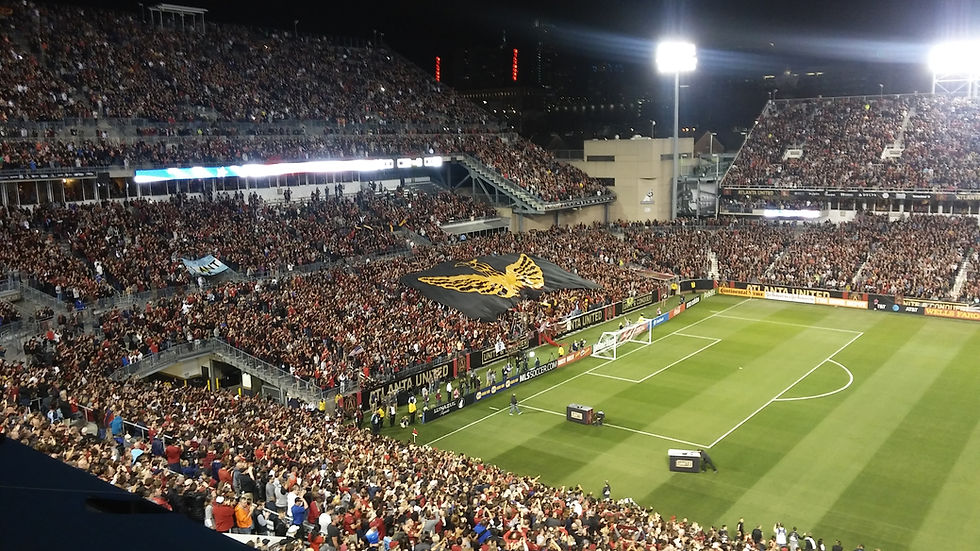
What actually happened was something nobody in American soccer had seen before. Sellouts. Atmospheres that belonged on another continent. An MLS Cup in 2018 before 73,000 people at a stadium that was barely a year old.

But the more important story is not the attendance numbers. It is what kind of soccer culture Atlanta produced. Most American soccer supporter communities, even the best ones, are performing a version of something imported: terraces, scarves, chants lifted from English traditions, a self-conscious effort to replicate something from somewhere else. Atlanta United's matchday culture grew out of Atlanta itself. The lineup announcement plays Shawty Lo. The music in the stadium reflects what the city actually listens to. The demographics of the supporter base reflect what the city actually looks like. When opposing fans complain about the amount of hip-hop played at Atlanta United matches, they were inadvertently identifying exactly what makes the club different from most other clubs in American soccer. It is not a suburban facsimile of someone else's soccer culture. It is authentically, specifically, irreducibly Atlanta.
That matters because it tells you something true about the city. The diversity that shows up on matchday at Mercedes-Benz Stadium is not an accident of stadium marketing. It is the product of a city that has spent decades becoming genuinely international, genuinely multicultural, and genuinely tolerant in the practical sense, not as ideology but as the necessary condition of a city that wanted to grow and understood that growth required everyone. That civic character, built over generations, is what Atlanta United inherited. The club didn't create it. It revealed it.
FIFA does not award semifinal matches to cities it isn't certain can handle them. Atlanta's track record with Atlanta United, with the SEC Championship, with the Super Bowl, with the Final Four, is why eight matches are coming here, including one of the four most important matches in the entire tournament. The city earned this specific assignment. It was not given.
The Infrastructure Argument Nobody Is Making Loudly Enough
One of the most underappreciated facts about Atlanta hosting the World Cup is what Atlanta is not having to do to host it.
Look at what other host nations have historically done to prepare for this tournament. Stadiums built from scratch in climates that required air conditioning the playing surface. Entire transportation networks constructed under deadline pressure. Cities reshaped at enormous human and financial cost to accommodate a three-week event.
Atlanta is not doing any of that.
Mercedes-Benz Stadium exists because Atlanta's growth demanded it, because Arthur Blank and the Falcons needed a new home, because Atlanta United needed a place worthy of its ambitions, because the city had spent thirty years building the case that it could support a world-class venue. The World Cup did not create that stadium. The stadium was always going to get built. The World Cup is simply the latest extraordinary event to benefit from it.

Centennial Olympic Park tells the same story. Carved out of a blighted warehouse district as part of the 1996 Olympic legacy, that 21-acre park became the largest urban green space constructed in the United States in more than twenty-five years. For three decades it has been one of the most genuinely public civic spaces in any American city, accessible to everyone, anchoring the city's core in a way that has only grown more valuable over time. The 1996 Games, which then-mayor Kasim Reed later estimated created a direct economic impact of at least $5 billion and rebranded Atlanta from a regional transport hub to a recognized center of international business, built the foundation the World Cup is now building on. The park does not need to be transformed for the Fan Festival. It needs to be celebrated.
What the World Cup is producing in Atlanta is real and additive: road upgrades, MARTA improvements, airport enhancements. These are investments the city needed and that the World Cup has accelerated and in some cases funded. When the tournament ends, Atlanta keeps the infrastructure. The bill for hosting is being paid in improvements that benefit residents long after the last match is played.
That is a different deal than most cities get. Atlanta negotiated it from a position of strength because it had already done the hard work.
The Catalyst Nobody Should Underestimate
The infrastructure upgrades are visible. The development story happening alongside the World Cup is quieter but may ultimately be more significant.
Centennial Yards, rising on 50 acres of underutilized space in the Gulch just steps from Mercedes-Benz Stadium, broke ground in November 2022 on two 19-story towers and announced in March 2024 an eight-acre entertainment district with a public plaza designed to be ready in time to welcome World Cup fans. Live Nation and Cosm, which is developing a three-level immersive Shared Reality venue for sports and entertainment, are among the key tenants. The Mitchell, the first residential tower, is already open and welcoming residents. This is not a rendering. It is a neighborhood in the process of becoming real.

South Downtown, centered along Mitchell Street two blocks from the stadium, is reimagining 58 buildings across 16 acres of the historic city center. Spiller Park Coffee, Atlanta Tech Village, and a wave of local food and retail operators have already opened. More are coming in 2026 and 2027. The goal is a walkable downtown neighborhood built around the creative and entrepreneurial community that Atlanta has been generating for decades but has never had a proper place to land.
These projects are not coincidences. They are what happens when a city with Atlanta's growth trajectory adds a global spotlight to an already compelling investment story. The World Cup is functioning as a catalyst, accelerating capital, accelerating timelines, accelerating the activation of parts of the city core that have been underleveraged for years.
This is how Atlanta has always worked. The major event creates the moment of visibility. The visibility attracts the investment. The investment creates the conditions for the next major event. The cycle is not accidental. It is the product of decades of deliberate institution-building by people who understood that Atlanta's ambitions required infrastructure that would attract the world's attention.
What Global Recognition Actually Does
There is a version of the global recognition argument that is purely emotional: the world will see our city and we will feel proud. That version is true and it is not nothing. But it understates what sustained global visibility actually produces for a city like Atlanta.
Eight World Cup matches, including a semifinal, means Atlanta is on the primary broadcast feed for billions of viewers across multiple weeks. Not a mention. Not a cameo. A sustained, repeated, high-production-value presentation of this city to an international audience that in many cases has only a vague sense of what Atlanta is and where it sits in the American landscape. Before the 1996 Olympics, a retrospective later noted, Atlanta was routinely confused by the international business community with Atlantic City. By the time the closing ceremonies were done, that problem was over. The World Cup will not be smaller than the Olympics.

The audience for that broadcast is not just soccer fans. It is business executives making location decisions. It is international talent evaluating cities for relocation. It is tourists planning future trips. It is investors looking at American markets they haven't fully explored. Atlanta's pitch to all of those audiences, a major international city with world-class infrastructure, a demonstrated capacity for execution, a genuine and authentically diverse soccer culture, and a cost of living that still compares favorably to the coastal markets, is a compelling one. The World Cup gives Atlanta the platform to make that pitch to everyone simultaneously.
The World Cup does not introduce Atlanta to the world so much as it reintroduces it, as something larger, more capable, and more globally connected than the world's prior mental image of it. And for anyone who experiences Atlanta's matchday culture firsthand this summer, the reintroduction will be genuinely surprising. This is not the Atlanta they expected.
What Comes Next
I have covered Atlanta soccer long enough to remember when the question was whether this city could sustain an MLS franchise. The answer to that question, delivered at 73,000 people on a rainy December night in 2018, changed the conversation permanently. Atlanta did not just sustain a soccer club. It produced the most authentically local soccer culture in the United States, and in doing so made the case that this city was ready for the world's biggest sporting event.
The World Cup this summer is not the destination. It is the latest turn of a cycle that has been running for sixty years. What gets built in and around the city core in the next five years, the developments already in motion, the infrastructure already being upgraded, the global relationships being formed in boardrooms and broadcast trucks this summer, will make the case for what comes after. The 2028 Super Bowl. A potential 2031 FIFA Women's World Cup bid. Whatever comes next that we haven't imagined yet.
One piece of that future arrived on May 7, 2026, a month before the World Cup kicked off. U.S. Soccer officially opened the Arthur M. Blank U.S. Soccer National Training Center in Fayetteville, Georgia, 25 miles south of downtown Atlanta. The 200-acre facility is the first national training center in the history of American soccer: 17 outdoor fields, two indoor fields, and 200,000 square feet of high-performance facilities and federation headquarters. U.S. Soccer moved its entire operation to Atlanta. The national federation is now based in the same metropolitan area that produced the Atlanta Chiefs, Atlanta United, and a semifinal. That is not a coincidence. It is a statement about where American soccer thinks its future lives.

Atlanta has never been a city that hosts something and then returns to normal. It hosts something and becomes more capable of hosting the next thing. That is the pattern. That is the long game. That is why the Atlanta Chiefs planted seeds in 1967 that are still growing, why Ivan Allen built a stadium for a team that didn't exist yet, why Centennial Olympic Park became a civic treasure instead of a temporary installation, and why a city that once wondered if it could fill seats for an MLS team is now preparing to welcome the world for a World Cup semifinal.
The city that built itself into this moment did it the only way Atlanta has ever built anything: imperfectly, ambitiously, with one eye on who it was and both eyes on who it intended to become. It did not get everything right. It kept moving forward. And the culture that fills Mercedes-Benz Stadium on matchday, diverse, loud, and entirely its own, is what it looks like when a city's stated values and its actual character finally start to match.


Comments