
The Beat Built the Blueprint: Atlanta's Long Road to 2028


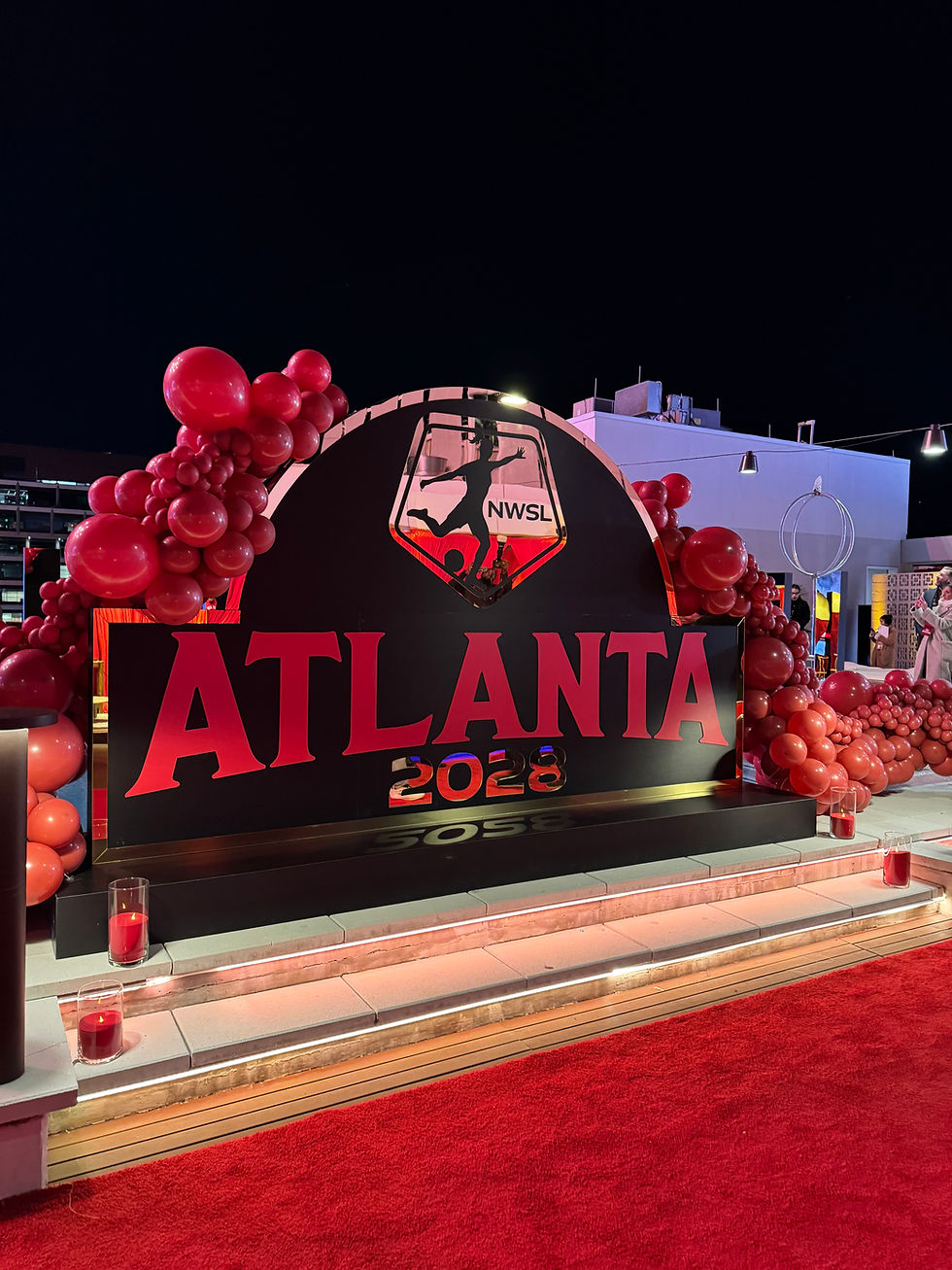
On November 11, 2025, at an event called Empower Her, Inspire All, Arthur Blank stood at The Interlock and introduced Atlanta's newest professional sports franchise, an NWSL team that will not play its first game until 2028. NWSL commissioner Jessica Berman stood beside him. So did Cindy Parlow Cone, president of U.S. Soccer, someone who had a role in scoring goals for Atlanta before she had a role in setting goals for women's professional soccer in the United States.
This is the third time Atlanta has tried. The first two teams were both called the Atlanta Beat. They never shared an owner, a stadium, or a single player. One ran from 2001 to 2003. The other ran from 2010 to 2011. Neither survived long enough to see the NWSL grow into the most successful women's professional soccer league in U.S. history. But both of them planted something. What Atlanta is building now, it is building on that ground.
Before the Beat
Atlanta had been laying this groundwork for decades before either Beat existed. Title IX opened the door nationally in 1972, and the push it set off for women's collegiate athletics through the 1970s and 1980s eventually made its way down to the high school level in Georgia. Cobb and DeKalb counties spent those years fighting, county by county, just to get girls' soccer recognized as a varsity sport, and it was not until 1992 that the GHSA finally sanctioned it statewide.
Linda Hamilton came out of that world. A Wheeler High School product in Cobb County who'd first learned the game on boys' teams, she made the U.S. women's national team in 1987 as a high school senior, promoted straight to the top alongside four other teenagers who would become the core of a legend: Mia Hamm, Kristine Lilly, Julie Foudy, and Joy Fawcett. Four years later, that generation won the first Women's World Cup in China. Hamilton became the first player from Georgia, by her own account possibly the first from Georgia of either gender, to earn a full national team cap.
By 1996, the growth was undeniable, and Georgia was at the center of it. Sanford Stadium in Athens hosted the Olympic women's soccer semifinal and gold medal match, the U.S. beating China 2-1 in front of 76,481 fans, a crowd that set a world record for attendance at a women's sporting event and stood as the largest audience anywhere to watch a standalone women's sporting event up to that point. The turnout caught even the tournament's own organizers off guard, and it did more than set a number. It proved the sport could draw at a commercial scale, and it helped pave the way for the sold out 1999 Women's World Cup three years later.
The U.S. women's national team played local friendlies at Decatur High School and DeKalb Memorial Stadium through the decade, building an audience one high school field at a time, and by 1999 more than 14,000 people showed up to DeKalb Memorial for a single friendly. A semipro club called the Atlanta Classics spent those same years playing USL W-League games at Adams Stadium under Emory coach Michael Sabatelle, developing local talent and participating in the only national women's soccer league at the time. When the Women's United Soccer Association announced itself in February 2000 as the first fully professional women's league in the world, coming off that 1999 World Cup win in front of 90,000 fans in Pasadena, Atlanta based Cox Enterprises signed on as a founding investor before the league even had a full list of cities.
It's Atlanta, Again
Cox Enterprises confirmed on April 10, 2000, that its WUSA franchise would call Atlanta home. The name arrived on November 2, chosen through market research and fan input to, in general manager Lynn Morgan's words, embody the city's musical heritage. Season ticket deposits started coming in before the team had a stadium locked down. Seventy percent of Atlantans surveyed said they were extremely interested in coming to a game, and the Beat had not played one yet.
The roster that formed that winter was as good as any in the new league. Briana Scurry, Cindy Parlow, and Nikki Serlenga were named founding players. Atlanta used the first overall pick in the inaugural WUSA draft on China's Sun Wen, FIFA's reigning co-Female Player of the Century, and added Homare Sawa from Japan and Charmaine Hooper from Canada. Julie Augustyniak, a Peachtree City product fresh out of Clemson, made the twenty player roster alongside her twin sister Nancy after two weeks of two-a-days in Atlanta and a final trial at the Olympic Training Center in Chula Vista, competing against roughly 160 players from around the world. "I made it," she remembered thinking. "I made it."
Tom Stone, who had scouted for the U.S. women's national team at the 1999 World Cup, was hired to lead the team and compete for trophies. "I could not be more excited about the challenge of coaching in the first women's pro soccer league," he said. "With Olympic athletes Parlow, Scurry and Serlenga, we've got a great foundation for a winning franchise."
The Best Team in a New League
Atlanta backed all of it up. The Beat drew 20,170 fans to Bobby Dodd Stadium for their opener on April 21, 2001, the largest crowd a professional soccer team had drawn in the city since the Atlanta Chiefs' 1968 friendly against Pele and Santos. The team kept averaging nearly 12,000 a game for the rest of the season. "A lot of little kids now see they have a dream they can reach," Parlow said after that debut. "And that's to play professional soccer."

On the field, the Beat were the class of the league. Charmaine Hooper scored the first hat trick in franchise history, and just the third in league history, in a 4-0 win that clinched the WUSA's first ever regular season title. Two weeks later, down 2-0 at halftime in the semifinal against Philadelphia, Atlanta scored twice in the second half and won it in overtime on a Cindy Parlow goal off her chest and left foot. "We fought for our lives in the second half," Stone said afterward. Atlanta went on to the first Founders Cup final in front of 21,078 fans at Foxboro Stadium. Nancy Augustyniak still calls it one of the best moments of her career. "That's like the culmination of my soccer career," she said, "getting to the championship and getting all the way down to the last second. What an experience. I'll never forget it."
The Beat made the playoffs all three years the WUSA existed, the only team in the league to do that, and reached the Founders Cup final twice in that span. They never won it. That is the honest ledger on Atlanta's first professional women's team: three seasons, two championship games, zero trophies. But no other club in the league got that close that often, and the sustained quality is what pulled the league's own headquarters to Atlanta that August, with Cox Enterprises providing the corporate infrastructure and former Beat executive Lynn Morgan named league president. For a stretch, the business center of American women's professional soccer ran out of Atlanta.
The Best Seat in Town
The Beat moved to Herndon Stadium at Morris Brown College for 2002 and 2003, a smaller, tighter venue three blocks from the Georgia Dome. Julie Augustyniak Tuff calls it her favorite stadium she ever played in, of her entire career, anywhere. "It was so intimate," she said. "I don't think there was a bad seat in the house. It invigorated me." The fan base that had shown up at Bobby Dodd followed the team over and kept growing, riding shuttle buses in from the parking lots on Saturday afternoons.

That closeness built something beyond a good crowd. Julie and Nancy Augustyniak made a habit of being among the last players off the field after every home game, signing autographs, showing up for every clinic and community appearance the team could book. "I took my job very seriously," Julie said, "and I thought we had an opportunity to positively influence young girls and to show them that they could have this dream." What she and her sister were offering, in her words, was something they had not had themselves growing up: strong women in sports for young girls to actually aspire to be. Julie remembers Nancy, who now does color commentary for South Carolina, running into a family at a game years later whose daughter was playing college soccer, they told her, because of the Beat. A stadium small enough to have no bad seat in the house is where a lot of those relationships actually got built.
Atlanta consistently being one of the best teams in the league helped as well. Sun Wen, healthy for stretches for the first time in the second season, helped lead a roster that reached the playoffs but fell in heartbreaking fashion in the semifinal on the road against the Carolina Courage. An 89th minute equalizer sent the match to extra time, where the Courage ended the Beat's dreams of playing in the Founders Cup in their own stadium. In 2003, the Beat signed Mexican international Maribel Domínguez and put together the league's second best regular season record, and broke San Diego's heart in the semifinal. Conny Pohlers' stoppage time goal leveled the match before Hooper's golden goal booked Atlanta's spot in the championship game. Founders Cup III saw Abby Wambach give the Washington Freedom the lead early before Hooper equalized from the penalty spot in first half stoppage time. Wambach's golden goal in the 96th minute gave Washington the title and the Beat another close call. They did not get a chance to get their hands on that trophy again.
What They Left Behind
The WUSA folded on September 15, 2003, a financial collapse that had everything to do with what the whole league failed to secure in television and sponsorship and spending that got out of control. What Atlanta built outlasted the paperwork. Wendy Parker covered the team for the Atlanta Journal-Constitution from the first kickoff to the final scoreboard, and her verdict has not changed. "WUSA and the original Beat, they created something out of nothing," she said. "Even though it was only three years, I think it's something that people who are interested in the history of this look back and say, that was pretty important."
The numbers behind that collapse were staggering from the start, and they had nothing to do with Atlanta specifically. The league entered its first season with a $40 million budget meant to stretch across five years and burned through all of it by the end of that first year alone, then finished its three seasons with roughly $100 million in total losses, undone by weak television ratings and a corporate sponsorship base that never came close to matching the crowds showing up at places like Bobby Dodd and Herndon. The league tried to fix it. In August 2001, fresh off Atlanta's first Founders Cup run, the WUSA rebuilt its front office around a new five year business plan, relocated its own headquarters to Atlanta, and brought in Tony DiCicco as commissioner. It still was not enough. Days after the September 15 shutdown, with that year's Women's World Cup kicking off in the United States that same week, Wendy Parker reported for the Atlanta Journal-Constitution that new investors had expressed interest in keeping the league alive. Nothing came of it. Professional women's soccer would not return to the United States for six years.
Beat players scattered into the game's next chapter. Some joined the Atlanta Silverbacks Women in the USL W-League, which kept a professional caliber women's team playing in this city through the gap years. Julie Augustyniak signed with a German club within months of the fold and kept playing overseas. "Atlanta was very, very good to me," Briana Scurry said, looking back years later. "I have incredibly fond memories of living there. It probably helped that that team was really, really good. We beat the heck out of everybody."
A New Stadium, A New Generation
Six years later, Atlanta got another chance. Women's Professional Soccer, the league that followed the WUSA, awarded Atlanta an expansion franchise for its 2010 season, and on June 18, 2009, a fan vote chose the name Beat over Attack and Storm. Owner Fitz Johnson partnered with Kennesaw State University, in Cobb County, the same county where Linda Hamilton had once had to fight just for a varsity season, to build a brand new 8,300-seat, soccer-specific stadium, a $16.5 million investment that gave the region a purpose-built home for the women's game for the first time. Beyond the name, the new Beat had no connection to the old one. Different owner, different roster, different corner of the metro. It was, in its own right, a fresh bet on the same idea.
That bet drew real talent. The Beat selected Ramona Bachmann, Johanna Rasmussen, and Mami Yamaguchi out of Sweden's Umeå IK in the international draft, then took U.S. international Tobin Heath, a future World Cup and Olympic champion, with the first overall pick in the college draft. More than 7,000 fans showed up for the new stadium's first game on May 9, 2010. That June, KSU Soccer Stadium hosted the league's All-Star Game, Abby's XI against Marta's XI, in front of 4,610 fans. That October, the U.S. women's national team beat China there, 2-1, in front of nearly 4,800 more. Midseason, when the league's St. Louis Athletica franchise folded, Atlanta absorbed five of its players, including Hope Solo and Lori Chalupny, a talent infusion big enough that bloggers started calling the team Atlantica.
One Last Class
The 2011 Beat opened preseason unbeaten in five straight friendlies against Auburn, North Carolina, Georgia, and Florida State, conceding a single goal. The league around them was contracting fast, and Atlanta felt it, but even in its final months the roster kept drawing serious talent. Fayetteville, Georgia native and future two-time World Cup champion Kelly O'Hara signed with the Beat that year. When Women's Professional Soccer suspended its upcoming season on January 30, 2012, the Beat's very last act, two weeks earlier, had been using the first overall pick in the league's final college draft on U.S. international prospect Sydney Leroux. Owner Fitz Johnson told reporters he would do everything he could to bring the team back the following year. The league itself never got the chance to let him try.
WPS's collapse was faster and messier than the WUSA's. The league had launched in 2009 with seven teams and never really stabilized. In an eleven month stretch, it lost franchises in Los Angeles, St. Louis, Chicago, the Bay Area, and Washington, D.C. By 2011, the Beat was one of only five teams left standing, alongside Boston, Philadelphia, Western New York, and Sky Blue FC in New Jersey, and the league had already stripped away its own $20,000 minimum player salary just to keep going. When Women's Professional Soccer suspended its 2012 season on January 30, it pointed to an ongoing legal dispute with an ousted franchise owner as the immediate cause, but the deeper problem was the same one that had killed the WUSA nine years earlier: not enough investment, not enough infrastructure, not enough runway underneath a good idea.
The National Women's Soccer League was founded the following year and did what neither of its predecessors could: it survived, and then it grew. More than a decade later, the NWSL fields sixteen teams and stands as the most successful women's professional soccer league in U.S. history, expanding rather than contracting, adding Boston and Denver in 2026 and now Atlanta and Columbus for 2028. Atlanta's new team will not have to find a college campus willing to host it or build a stadium from scratch. It will play at Mercedes-Benz Stadium under an ownership group, Arthur Blank's, that already runs Atlanta United and the Falcons. Before the club had even picked a name, it signed a seven year, $28 million front of jersey deal with Aflac, the largest of its kind in women's sports history. The instability that ended both versions of the Atlanta Beat is not the environment this team is walking into.
The Blueprint
Both versions of the Atlanta Beat measured their lives in a handful of seasons. Neither measured its impact that way. Julie Augustyniak Tuff, reflecting on it in October 2023, put the case plainly. "I think that we showed Atlanta that we can make this work here," she said. "I hope if nothing else, we did help inspire the whole Atlanta United." She said it two years before anyone had announced Atlanta was getting another chance.
Cindy Parlow Cone has said something close to the same thing, in her own words, from the other side of the sport now. Looking back on her time with the first Beat, she told Front Office Sports in 2026 that she loved how "the community, and the media in the area, and the corporate community just kind of rallied around our team and made us their team, which was really special," adding that it was "uncommon at that time" for a city to embrace a women's team the way Atlanta did. She said it as president of U.S. Soccer, the same person who scored the golden goal at Bobby Dodd back in 2001.
Arthur Blank's ownership group paid a $165 million expansion fee for the new team in November 2025, nearly triple what an NWSL expansion fee had cost just two years earlier. His son Josh, now vice president of executive strategy for AMB Sports and Entertainment, has put the business logic behind that number in plain terms: Atlanta already had the grassroots soccer culture, it just never had a local team to claim it. The city, he said, needed "that local team that could come and capture all of these people who loved the sport and played the sport, but they were fans of teams that were thousands of miles away."
The new team's headquarters and training facility are going up now on Franklin Gateway in Marietta, a short walk from where Atlanta United already trains. That is Cobb County, the same county where Linda Hamilton once had to fight for a varsity season, and where the second Beat played its home games at Kennesaw State. Three different chapters of this story, decades apart, have now landed in the same few square miles. Wendy Parker, who covered the first Beat's opening kickoff and its final press release for the Atlanta Journal-Constitution, is still on the beat. In March 2026, writing for the Cobb County outlet she now edits, she covered the news that Marietta had struck the deal to bring it home.
The players who wore the Atlanta Beat crest are not a footnote to what Atlanta is building now. They are the reason there was ever a case to make.


Honestly, can’t wait to take my girls to matches here. Super excited!