
The City That Got Told No

Atlanta spent four years trying to get the 1994 World Cup. It didn't make the cut. This summer it hosts a semifinal.
The day after FIFA awarded the 1994 World Cup to the United States, Atlanta was not on the list.
That was July 5, 1988. The preliminary roster of 16 potential host cities had been drawn up, and Georgia's capital was not among them. Four southeastern venues made the cut: Joe Robbie Stadium and the Orange Bowl in Miami, the Citrus Bowl in Orlando, and Tampa Stadium. Atlanta was nowhere. Billy Payne, the man who had just successfully lobbied for Atlanta to become the U.S. nominee for the 1996 Summer Olympics, read the news and immediately started making calls. "We think there is room for, and a need to, bring games to Atlanta," he said. "Assuming we can come up with a suitable stadium, I think we'll make a strong argument. We'll sure take a shot at it. The U.S. Soccer Federation is aware of our interest. They've told us the door is open."
Homer Rice, Georgia Tech's athletic director, was already thinking practically. Georgia Tech's Grant Field was the most logical Atlanta venue. "We've talked about the turf situation with the Olympic people," Rice said that day. "We might even have a grass field by 1994. And even if we didn't, it would be simple to bring grass in temporarily. We would definitely be interested in hosting one or more World Cup games. If it's good for the city, we're for it."
That phrase of Payne's, "we'll sure take a shot at it," turns out to be a reasonable summary of Atlanta's entire relationship with international soccer over the next 35 years. The city kept taking shots. It was not even a consideration when the USSF put together its bids in 1983 and 1988, before the World Cup was awarded to the United States. It tried to insert itself into the list of host cities for 1994 and did not get over the line. It was part of the U.S. bid for the 2018 and 2022 tournaments in 2009, but FIFA went elsewhere. Then the United Bid for 2026 came together, and Atlanta was a central part of it from the beginning. Each time the city came to the table, it came with more. Each time, the foundation was stronger. And this summer, the result is eight World Cup matches at a stadium that did not exist when any of those bids were made, including a semifinal on July 15.
The Bid
Atlanta's early strategy was deliberate restraint. Anne Duncan, manager of the Atlanta Sports Council, acknowledged as much on the day after the World Cup was awarded to the United States. "A lot of cities have been very aggressive," she said, "but our understanding has been that if we played in the background but got in position, we'd be in good shape." She was a lifelong soccer player who believed in what the sport could become. There were more than 54,000 youth players in soccer leagues across Georgia at the time. The market was there. The strategy, unfortunately, was wrong.
The timing was also complicated from the beginning. The Olympics and the World Cup were on a collision course in Atlanta before either bid was finalized. Payne had been driving the Olympics effort since 1987, building toward the USOC nomination Atlanta received in April 1988. When FIFA awarded the World Cup to the United States three months later, in July, Atlanta was simultaneously pursuing the two biggest sporting events on earth, with no clear answer yet on where either of them would actually be played.
On September 18, 1990, in Tokyo, the IOC awarded the 1996 Summer Games to Atlanta. The Atlanta Journal splashed "It's Atlanta!" across its entire front page that evening. Billy Payne's cadre of volunteers had pulled off what the rest of the country had considered impossible. Governor Joe Frank Harris stood outside the Atlanta Hilton giving thumbs up. The Dream Team, 58 young Atlanta volunteers Payne had sent to Tokyo to open doors for the bid, were singing in the streets. Payne told the IOC: "You know Atlanta. You know we are good at organizing things. You have been our partners. We will not let you down." One resident, polled in the street that day, captured the mood: "I'll stay here forever. It will bring in the money, and I think the people here will enjoy it."
But on the same day, in the same paper, a different headline ran: "Atlanta scores Games, now city seeks the gold." The Olympics had been won. The work of leveraging it was already beginning. And for the World Cup bid that was already in motion, the IOC decision was a double-edged result. Atlanta had proven it could host the world. It had also just created the exact conflict that FIFA president Joao Havelange most feared.
The city's organizing effort for the World Cup came together through 1990 and into 1991. Lewis Holland, a senior vice-president at Kidder Peabody, headed the bid. In January 1991, Atlanta World Soccer formally submitted its application with Grant Field as the proposed venue. Atlanta made the short list of cities in March, survived the cut to 19 in October, and Mayor Maynard Jackson personally flew to Los Angeles in May to make the oral presentation alongside Georgia Tech president Pat Crecine, co-chairmen Holland and Brian Dyson, and Atlanta Sports Council executive director Robert Dale Morgan. Crecine committed to a $20 million expansion of the stadium from 46,000 to 60,000 seats to strengthen the application. FIFA's technical committee toured the facility that July.
The tour did not go well. The inspectors were taken aback by the size of the stadium, the smallest in the running among the remaining cities. Dennis Berkholtz, coordinator of the Atlanta bid, said the FIFA members were impressed by the auxiliary facilities, but the stadium itself was a problem nobody could paper over. "We didn't roll out the red carpet," bid committee member John Bevilaqua said afterward, "and they didn't like the stadium."
There were larger problems too. Havelange had actually lobbied the IOC to award the 1996 Games somewhere other than Atlanta, precisely because he did not want the Olympics overshadowing his World Cup in the United States in 1994. Atlanta winning both events would put him in a difficult position with his own tournament. Atlanta-Fulton County Stadium would be unavailable in the summer of 1994 because of the Braves. The Olympic Stadium was not yet built. And Coca-Cola, the Atlanta-headquartered company that paid $18 million for World Cup sponsorship rights, was reluctant to lobby hard for its own city after being accused of buying the Olympics for Atlanta. The most powerful corporate voice in the room stayed quiet.
Bevilaqua later said World Cup USA had actually advised the Atlanta committee to take a low-key approach, and that they should have ignored that advice and "overdone it" the way they had for the Olympics. By January 1992, Berkholtz was telling the Atlanta Constitution the bid "could go either way."
In the final week before the March 23 announcement, the Atlanta committee was still trying. The last real card was Billy Payne. Holland made it explicit to the Atlanta Journal: "All Mr. Payne needs to do is agree to making the Tech stadium an Olympic soccer venue. That would go a long way to helping us get the World Cup here." FIFA wanted the legitimacy of having Olympic soccer played in Atlanta. If Payne said yes, there was still a path. But the stadium sat in the middle of the planned Olympic Village, the IOC had to approve, and the logistics were not cooperating. Bevilaqua was telling reporters the quiet part out loud: "It's not time to concede, but we're not in the same position with some venues as we would be to say 'It's Atlanta.'"

On March 23, nine cities were chosen. Scott LeTellier, the managing director of World Cup USA, said Bobby Dodd Stadium was not the same quality as venues like Joe Robbie Stadium in Miami and Stanford Stadium in Palo Alto, and that Atlanta-Fulton County Stadium was unavailable because of the Braves. Holland said it plainly in the paper the next day: "In all candor, the Olympics was a governing factor. The fear of being overshadowed by the Olympics just could not be overcome." He sent a letter to World Cup USA anyway: "Should any of the nine cities falter, we stand ready, willing and able to pick up the ball."
They did not get the ball.
The Games That Built the City
Atlanta did not host the 1994 World Cup. It hosted the 1996 Summer Olympics instead, and that turned out to matter more.
The Games reshaped the city physically in ways that are still visible from every angle of downtown Atlanta today. Centennial Olympic Park was carved out of what had been a blighted warehouse district and became the civic anchor it still is. Hotels were built. Transit expanded. The Georgia World Congress Center grew into one of the largest convention facilities in the country. The city that Payne had sold to the IOC as a global destination had to become one, and it did.
The soccer thread ran through it, too. The United States women won the gold medal at the University of Georgia's Sanford Stadium in Athens in front of 76,481 people- the largest crowd ever to watch a women's soccer match at that time. Kids who watched that summer went looking for places to play. Youth soccer registration in Georgia, already north of 54,000 players statewide in 1988 and growing steadily, accelerated further.
What the Olympics also produced, less visibly, was a generation of civic and corporate leaders who understood how to host the world and had done it. The relationships formed, the infrastructure built, the international credibility earned: all of it compounded. The page 6 headline on the day Atlanta won the Olympics said it directly: "Atlanta scores Games, now city seeks the gold." The next major event. Always the next major event. When the conversations about an MLS franchise and a new stadium began in earnest in the 2010s, Atlanta was not starting from scratch. It was building on a foundation the Olympics had poured.
Bobby Dodd, Again
On April 16, 2014, MLS Commissioner Don Garber stood in Atlanta and made it official. Arthur Blank had been awarded an expansion team that would begin play in 2017, playing at a new world-class stadium to be built in downtown Atlanta. The announcement was not a surprise to anyone paying close attention. Since 2008, Blank and executives from the Atlanta Falcons and AMB Group had been working closely with MLS to bring top-flight soccer to the city, visiting six MLS markets and holding discussions with another six clubs. Garber pointed to what was already there: during the previous few years, crowds of more than 50,000 fans had regularly attended international soccer matches in Atlanta, with nearly 70,000 showing up for a March match between Mexico and Nigeria. The market was not a theory. It was already filling stadiums for games that had nothing to do with Atlanta.

Mercedes-Benz Stadium was under construction next door to the Georgia Dome, built for the Falcons, a future soccer team, and potentially the World Cup. The club would not have its permanent home ready when it began play in 2017, so it needed a temporary one.
The choice was Bobby Dodd Stadium, as Grant Field had been renamed in 1988. Georgia Tech's old facility, the same building FIFA's inspectors had toured in the summer of 1991 and found wanting, became Atlanta United's first home. The club paid the university more than $1 million for the use of the stadium and it looked like a completely different venue that what failed to impress FIFA inspectors back in 1991. On March 5, 2017, Atlanta United played its first regular-season match there- and 55,297 people showed up.
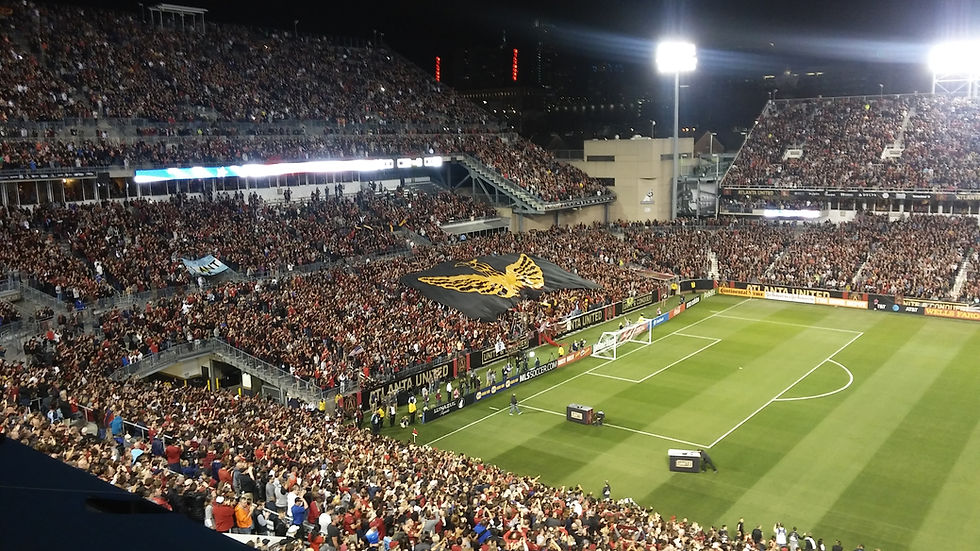
That number is worth sitting with. Bobby Dodd's capacity is roughly 52,000. Fans filled the building past its stated limit for a brand new club's first game. The same stadium that was deemed too small for the 1994 World Cup that held back the bid, that FIFA's inspectors shook their heads at, was packed past capacity for Atlanta's first MLS match. By September Mercedes-Benz Stadium was ready and Atlanta United moved in permanently to a building that was, from its first day, one of the finest soccer venues in the country.
Tata Martino was in the dugout. Josef Martínez would score 19 goals in 20 matches that inaugural season.
What Happened Next
The 2018 season is already a piece of Atlanta sports history. Martínez scored 31 goals- breaking the MLS regular-season record- and won All-Star, regular-season MVP, and MLS Cup MVP honors in the same year, the first player in league history to do so. Atlanta United pulled 901,033 fans through the turnstiles across a 17-game regular season- another league record. The atmosphere on matchdays at Mercedes-Benz Stadium was something American soccer had not seen before: genuinely diverse, rooted in what Atlanta actually listened to and looked like, not a performance of someone else's soccer culture imported from somewhere else.
On December 8, 2018, 73,019 people were inside Mercedes-Benz Stadium for the MLS Cup final against the Portland Timbers. Atlanta won 2-0. It was the first major sports championship for the city since the Braves in 1995. The attendance record for an MLS Cup title game still stands.
What the 2017 and 2018 seasons established, permanently, is that Atlanta was a real soccer market- not a projection, not an aspiration, not a demographic theory.
The world noticed. In June 2024, CONMEBOL chose Mercedes-Benz Stadium to host the opening match of Copa América. Argentina, the defending world champions, and Canada kicked off the entire tournament in Atlanta. The city that could not get into the 1994 World Cup was now where the oldest and most prestigious national team tournament in the Western Hemisphere began.
A year later, the FIFA Club World Cup came to town. Mercedes-Benz Stadium hosted six matches of the expanded 32-club tournament in June and July 2025- including a quarterfinal between Paris Saint-Germain and Bayern München. Chelsea, Manchester City, Inter Miami, and Porto all played on that field in the summer before the World Cup. Doug Roberts, the stadium's vice-president for events, put it plainly when the Club World Cup was announced: "Mercedes-Benz Stadium has quickly become known for hosting the biggest soccer matches in the U.S." That reputation was built match by match, tournament by tournament, from the MLS Cup in December 2018 forward.
The Semifinal
This summer, Mercedes-Benz Stadium hosts eight matches of the 2026 FIFA World Cup, including a semifinal on July 15. The economic impact for the city is projected at $415 million. FIFA temporarily rechristened the building "Atlanta Stadium" for the tournament. The Uzbekistan national team is training at Atlanta United's Children's Healthcare of Atlanta Training Ground as their official base camp.
The city that was told in March 1992 that it was not among the nine chosen- that its stadium was too small, that the Olympics would overshadow the tournament, that the facilities had not impressed- is now one of the premier venues in the biggest World Cup in the history of the sport.
Bevilaqua's 1992 postmortem still reads clearly: "We started late. This city had an Olympic-size hangover, and we weren't quite as aggressive or ambitious as cities such as Dallas on the front end." That was true. Dallas made the 1994 cut. Dallas is hosting World Cup matches this summer too. But Atlanta's path got there differently. What it built along the way- the club culture, the attendance records, the infrastructure, and the international credibility- is something that was not there in 1992 when the inspectors left Bobby Dodd shaking their heads.
Lewis Holland sent that letter in March 1992 offering to pick up the ball if a 1994 host city faltered. No city faltered, and Atlanta had to build its own ball instead. It took about 30 years to get there, but…
It turned out to be a World Cup semifinal.
Atlanta's first 2026 World Cup match is June 15 at Mercedes-Benz Stadium.


Comments